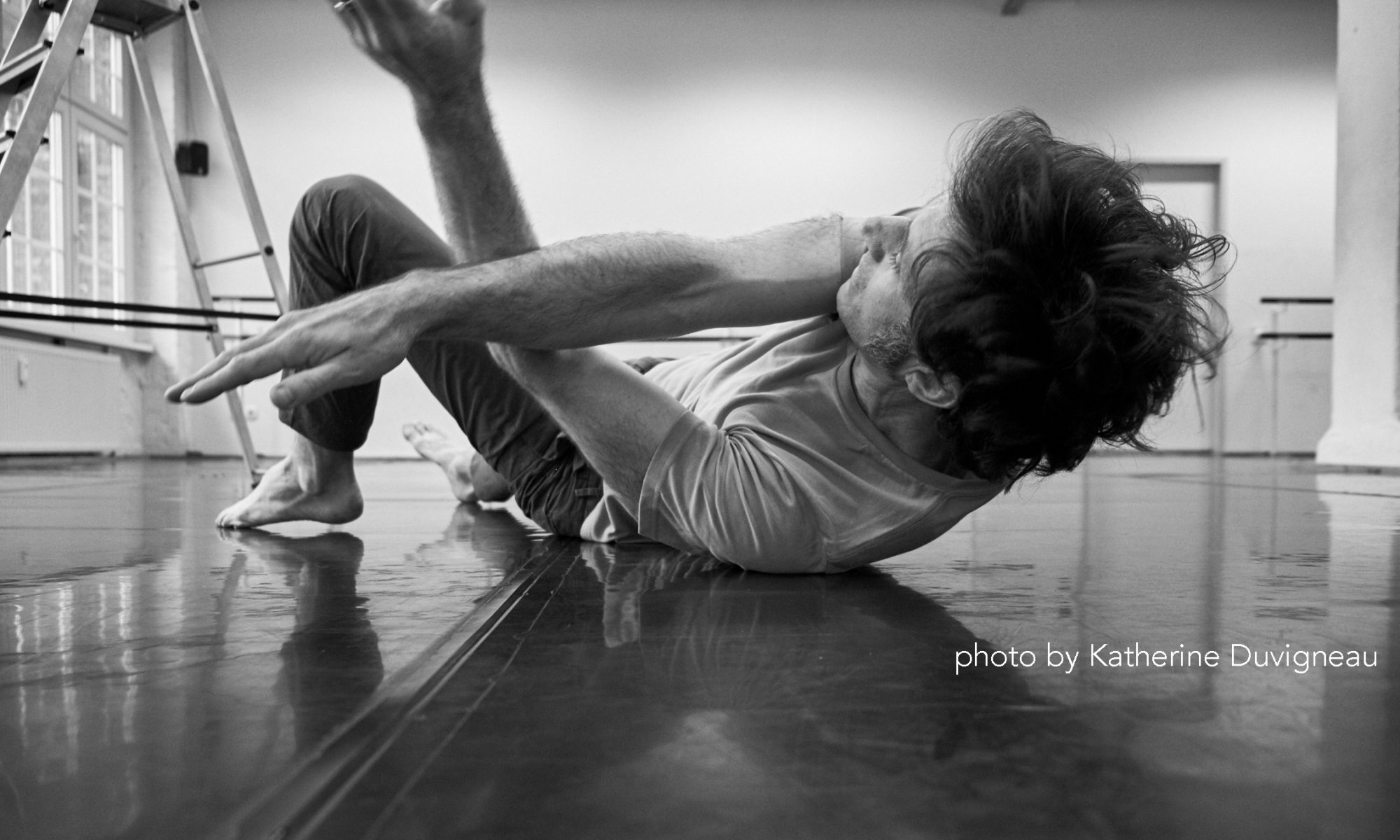
Another definition of choreo and impro

Choreography and improvisation are both a set of rules to follow during a performance.

One is usually a longer more detailed set; the other is shorter.

One has a wide range of acceptable outcomes; the other has fewer.

Dance is a Visual Art

Here are some links to compositional ideas for painting and photography that I think apply to dance. Especially in relation to the instant choreo composition modality of Ensemble Thinking.

The Rabatment of the Rectangle
http://en.wikipedia.org/wiki/Rabatment_of_the_rectangle

The Rule of Thirds
http://en.wikipedia.org/wiki/Rule_of_thirds

The Rule of Odds
http://photo.stackexchange.com/questions/11475/what-is-the-rule-of-odds

Placement of Elements
http://painting.about.com/od/composition/ss/composition-painting-elements.htm

The Painting’s Secret Geometry
http://www.francois-murez.com/composition%20en.htm

p.s.
if dance is a visual art, why are the people who watch it called an audience?

Arts, as they descend into entertainment, cling to seriousness and sadness as a means of validation. This leads to dismissal of humor as less valid because it highlights the lack of valence of the performing arts as affecting any real change.

Descend into entertainment can also be read as becoming a commodity; appropriated by the capitalist market.

Tour vs. Make

Hot off the mental press, coming at you live. As I ponder more and more of late about what to do in life, what path to follow or forge, all due to grad school and the birth of my first child, I think now about a binary of touring vs. making work. Is it even a binary? All these thoughts could be because I am just lazy and don’t want to do the work of getting my work out there. Writing grants, making packets, sending them out, schmoozing with presenters is a lot of work. Work that scares me. Maybe scares me is the wrong word.

I see other artists who tour and get presented and looking at their work, I don’t understand why they were presented, why the director of theater X gave them a 6 month residency. Must be in the documentation the artist presented, or maybe the kind of work s/he does is more easily marketable. Could be that my work is just not interesting. Don’t get bitter, don’t get bitter, don’t get bitter.

And grad school, context, context, context. Shit in on context smell, a different context helps make food. So maybe I need to rewrite all my performance blurbs so the context is sexier. And then write the grants, make the packets, and hound the presenters. But for whom am I making the work? Because I work in a time based medium that can be viewed as performative, does that mean the work is made for other people? How many painters make work for themselves, and have studios full of canvasses not meant for general consumption?

And now a child! What a wonderful bundle of joy and confusion. Her laughter, smiles and cries make everything, all my frustrations disappear. But then they come back. Provide, provide, provide…that is what a parent, a father is supposed to do. Hack away at performing, etc to make money to provide. But then touring could conflict with schooling. School is still a couple years off yet.

So, do I finish this schooling, get my MA then jump out of the artistic realm into the academic realm to get health insurance, income to provide? Just as much chance of getting a big grant. Both require applications and schmoozing.

Maybe this is all justification for laziness. Artistic high road and all that. Even now all these thoughts/emotions I don’t want to bother to craft into a polished blog post. But isn’t this more just for me as a place to vent?

No one reads this anyways…

waaah
waaah
waaah

What is it?

Flo eminates from the kitchen.
Grub is collated frantically.
Foxy lemmings kite checks.
Worst Oma eliminates four tiny kittens.
Bald Mary stems collegial fraternizing.
The rebar knows kind chicks.
A kangaroo taps foul Tibetan koans.
The wild bran challah collective failed.
We all got tan in Kay’s chalet.
The tilted atrium failed the kinetic colloquial festival king’s child.

The Need for Context

The need for contextualization exists because humans can not free themselves from the good-bad binary. That being said, contextualization is also needed because we are now in a post-disciplinary moment. How long that moment will last is another question.

Because we are in a post-disciplinary time and still are saddled with the evaluative binary, we need contextualization to help us determine where a given work of art/documentation/performance/representation lies on that spectrum. For better or worse, we are no longer saddled (not really but roll with it) with the evaluative binaries of disciplines, which are themselves shorthands for contextualization.

Osama

Hmm…Osama is now dead and his body was dumped out to see. Of course, the U.S. military observed strict Islamic protocol before they dumped his body. So as not to enrage anyone. When are the photos of the Navy Seals or Delta Force or whoever caught him going to surface? The photos with the soldiers posing with empty beer cans, hot dogs and Osama’s dead body?

That question aside, I think it is quite remarkable that the US found him without co-operation by the Pakistani government. We give them billions every year, his compound was within spitting distance of a Pakistani military base. What I bet happened is that the Pakistani government co-operated fully with the understanding that the US government would make a big stink about how they received no co-operation. That way the Pakistani government gets full deniability(sp?) and the US gets Osama. A win-win situation. Yes, there have been some deaths due to do protests/retaliations by Osama supporters.

But imagine how much worse it would have been if the Pakistani government had publicly supported his capture and been excited by his death?

Also, what happened to due process of law and trial by a jury of peers? Or are those not unalienable self-evident rights…?

John Cleese on Terrorism

The English are feeling the pinch in relation to recent terrorist threats and have therefore raised their security level from “Miffed” to “Peeved.”

Soon, though, security levels may be raised yet again to “Irritated” or even “A Bit Cross.” The English have not been “A Bit Cross” since the blitz in 1940 when tea supplies nearly ran out. Terrorists have been re-categorized from “Tiresome” to “A Bloody Nuisance.” The last time the British issued a “Bloody Nuisance” warning level was in 1588, when threatened by the Spanish Armada.

The Scots have raised their threat level from “Pissed Off” to “Let’s get the Bastards.” They don’t have any other levels. This is the reason they have been used on the front line of the British army for the last 400 years.

The French government announced yesterday that it has raised its terror alert level from “Run” to “Hide.” The only two higher levels in France are “Collaborate” and “Surrender.” The rise was precipitated by a recent fire that destroyed France’s white flag factory, effectively paralyzing the country’s military capability.

Italy has increased the alert level from “Shout Loudly and Excitedly” to “Elaborate Military Posturing.” Two more levels remain: “Ineffective Combat Operations” and “Change Sides.”

The Germans have increased their alert state from “Disdainful Arrogance” to “Dress in Uniform and Sing Marching Songs.” They also have two higher levels: “Invade a Neighbor” and “Lose.”

Belgians, on the other hand, are all on holiday as usual; the only threat they are worried about is NATO pulling out of Brussels.

The Spanish are all excited to see their new submarines ready to deploy. These beautifully designed subs have glass bottoms so the new Spanish navy can get a really good look at the old Spanish navy.

Australia, meanwhile, has raised its security level from “No worries” to “She’ll be alright, Mate.” Three more escalation levels remain: “Crikey!”, “I think we’ll need to cancel the barbie this weekend” and “The barbie is cancelled.” So far no situation has ever warranted use of the final escalation level.