A Couple Thoughts onGravity

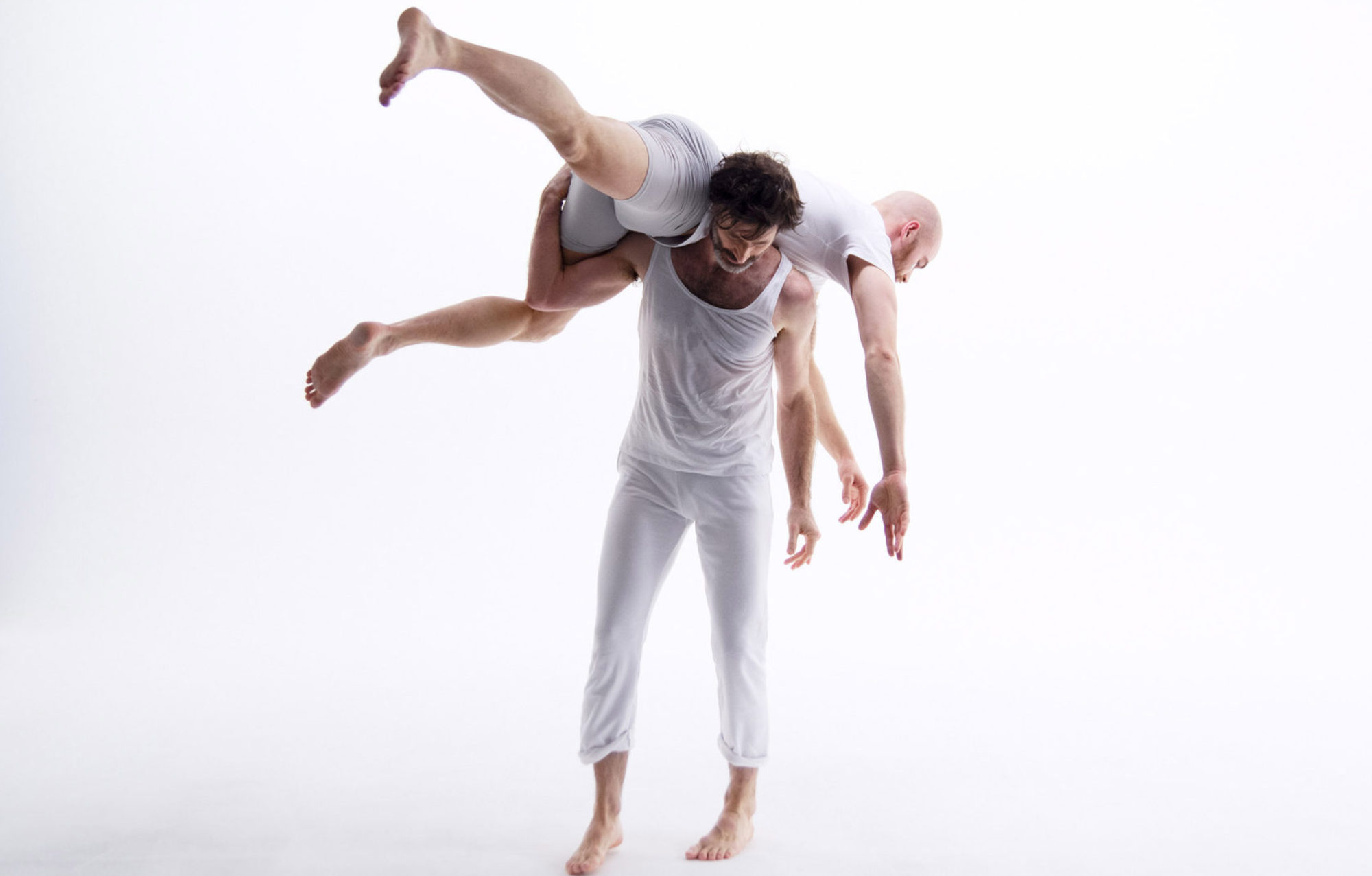
A brief discussion of gravity on WhatsApp with my Lower Left colleagues in relation to dance styles got me to think about how/if I relate CI to gravity. I do occasionally refer to gravity especially when teaching partnering pathways, of how at the top of the arc a person has no weight because for a moment gravity is no longer acting on them, and how weight lessens as someone goes up and increases as they go down. Making them easier to move on the way up and at the top, rather than down. Also this week in my CI class at Marameo, I referred to the altas vertebra, having people tilt from there to sense the pressure change under their feet.

So one current hypothesis is that the earlier generations of CI practitioners were heavily into gravity because they were looking for an outside source to move and inspire them, rather than predetermined movements. That it was a post-modern move to relinquish agency to an outside source other than the individual’s will to generate the movement, a mode of killing the choreographer.

I tend to focus on the creation, operation, and dissolution of surfaces of contact, i.e., the improvising of the contact surfaces, their number, location, size, degree of pressure rather than gravity. 

For me the focus on gravity relates to the first two phases of CI, sensing and mechanizing. Once a dancer is familiar with those phases, they can venture into the third phase – improvising. Another hypothesis is that much of CI teaching remains within sensing and mechanizing, and merely lets the improvising happen as a result of adapting to failed attempts at repeating pathways, at least that is what I would say from a lot of what I see here in Berlin, rather than having the improvising with and in contact be a conscious artistic choice in the moment.

(at some point, I will write more about the three phases of sensing, mechanizing, and improvising)

Solarized Camper Shell

The crude image above is the top view of a truck, a Ford F150 Lightning, for example. With a campershell. Now imagine that this campershell has 4 solar panels on it, stacked on top of each other. Panels 2-4 slide out and are supported by a telescoping leg and by a frame underneath. These solar panels, if they are 800W panels could generate 2400W/hour on a decently sunny day. This electricity could then be fed right into the truck’s battery to power a cooler, an electric grill, the truck itself.

Considering how lighter and cheaper solar panels are getting, it seems like a pretty feasible idea.

Thoughts?

Dance Improvisation as diagnosing

Below is a modified text and the original text from page 247 of Richard Sennett’s The Craftsman. I think a person experienced in improvising, dance for example, is similar to an experience doctor diagnosing a patient. The person with experience thinks in larger units of time, makes me think of the movemes from the chapter on Tango in the Oxford Improvisation in Dance tome. I think also a person with experience can also think in smaller units of time, thinking of Nita Little’s Thin Slicing of time. An person with experience can oscillate between large and small units of time, anticipating on several scales.

Modified Text

The experienced improviser, as one would expect, is a more accurate diagnostician.This is due in large part to the fact that he or she tends to be more open to oddity and particularity in movement, whereas the novice is more likely to be a formalist, working by the book, rather rigidly applying general rules to particular cases. Moreover, the experienced improviser thinks in larger units of time, not just backward to cases in the past but, more interestingly, forward, trying to see into the dance’s indeterminate future. The novice, lacking a storehouse of histories, has trouble imagining what might be an individual moment’s fate.

Original Text

The experienced doctor, as one would expect, is a more accurate diagnostician. This is due in large part to the fact that he or she tends to be more open to oddity and particularity in patients, whereas the medical student is more likely to be a formalist, working by the book, rather rigidly applying general rules to particular cases. Moreover, the experienced doctor thinks in larger units of time, not just backward to cases in the past but, more interestingly, forward, trying to see into the patient’s indeterminate future. The novice, lacking a storehouse of clinical histories, has trouble imagining what might be an individual patient’s fate.

Better Late Than Never

below are some photos of a performance I did with my son, Eli, at marameo, e.V. in Berlin, Germany on April 11, 2026. We danced to a soundtrack I made. The text is about dreams I had shortly after my father died when I was 22 and questions about fatherhood. The soundscape beneath the text is the sound of Magnesium to performance that gave rise to contact improvisation. The photos were taken by Laurence Chaperon.