In artworks, form is aesthetic insofar as it is an objective determination. Its locus is precisely where the work frees itself from being simply a product of subjectivity. – Theodor Adorno, Aesthetic Theory pg. 142
re-lease technique
As a choreographer, a dancer, a dance maker, and a performance theorist, I try to learn and understand as much as possible about my chosen field(s) of knowledge production. This knowledge accumulation process involves seeing a variety of performance, ranging from performances happening in black boxes and white boxes, high budget and low budget performance. It also entails reading a variety of books about visually oriented work – a history of ballet, Barthes, 7 Days in the Art World. So, yeah, me! I’m trying to expand my mind/range.
What particularly interests me, though, are the roots or building blocks of all this textual knowledge, i.e., words. And as I am a (stuck, maybe) a post modern dancer, I am interested in taking apart ideas to see what the inner workings of it are. But enough of this, let’s cut to the chase.
Release technique. What is it? Wikipedia, the compendium of all current truth and knowledge, defines it as “…an umbrella term that encompasses a variety of different corporeal practices that emphasize efficiency of movement in dance. Emphasis is placed on breath, skeletal alignment, joint articulation, ease of muscular tension and the use of gravity and momentum to facilitate movement.”
Fine, sounds good. We’ll take it. But let’s go deeper. Re-lease. The prefix of re- denotes something happening again, as in a re-petition of something. As in a rechaulking of your bathroom tile because it is so old and you don’t want the water to leak through to the walls and floor and cause the wood to rot.
And what is the lease that is happening again? Well, a lease, if you have ever rented an apartment or leased a car, is a contract. You sign your name on a piece of paper saying that you will pay so much a month to be able to store all your stuff (cue George Carlin) and cook, sleep, shower and shave in a place for a given period of time. For a car, it’s slightly different. I am not exactly sure because I have never leased a car. Why you sign a lease to rent an apartment, but sign a contract to rent a car, I don’t know.
Regardless, and not irregardless(!), a lease involves a contractual agreement between two parties for a specific amount of time. Contractual…what word is hidden in there? Contract. And what contracts? Muscles. Yes, muscles. So what do we have thus far?
Release is a repetition of a contract between two parties for a specific amount of time.
In the human body those two parties could be said to be the myosin fibers of the muscles that pull against each other when the nerve attached to that muscle receives a the signal to sign the contract. And as something can only contract again if it has been relaxed, release technique is not the “focus on the ease of muscular tension” but actually the opposite. It is the focus on the repeated engagement of muscles, or focus on the repeated creation of muscular tension.
Same coin, but the opposite side.
Teleological Posited Goal
“Investigation…uncovers what is going on independent of any consciousness in the objects in question, while on the other hand it discovers in them new combinations and new functional possibilities which need to be set in motion in order to realize the teleologically posited goal.” pg 11-12 The Ontology of Social Labor 3. Labour by Lukács.
This to me sounds like the experimentation phase of improvisation.
Also had the thought that improvisation has no teleologically posited goal. Unless it is scored and that is the teleologically posited goal.
Improvising the technically pedestrian choreography
“While improvisation initially offered Jones a reprieve from the demands of technical training…” – page 115 from I Want To Be Ready by Danielle Goldman.
This quote refers to the choreographer Bill T. Jones. While it may be true that improvisation did offer Jones a respite from the rigors of technical training, I find that this statement sets up, or rather is indicative of an old and antiquated antagonistic binary about improvisation and technique.
I would say that good improvisation requires technical training. The opposite of improvisation is choreography. And to do choreography doesn’t require technical training but merely memory.
A dancer’s relationship to time, i.e., improvisation or choreographed, has nothing to do with technical training. Choreography can be technical or not, improvisation can be technical or not. Though, I would posit that untechnical improvisation isn’t improvisation, but merely futzing about, regardless of how enthusiastic it is. Choreography, on the other hand, is merely remembering a sequence of events.
Technical, pedestrian, improvised, choreographic…one does not imply the other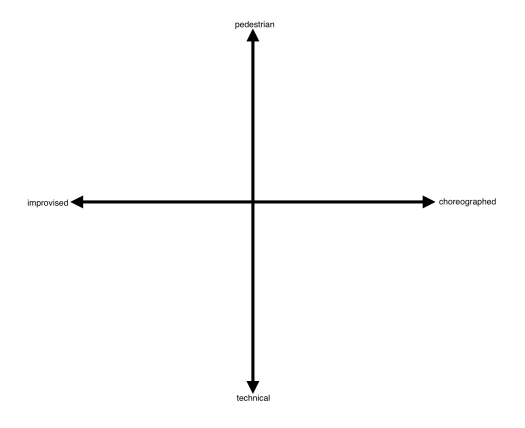
Labor and Dance
the edited phrase
“Lukács emphasizes that in the course of history, the [critical], [theoretical] understanding of [dance] becomes more and more detached from the labor process, and less and less immediately bound to the immediate material constraints of the [dance].”
the original phrase
“Lukács emphasizes that in the course of history, the abstract, scientific understanding of reality becomes more and more detached from the labor process, and less and less immediately bound to the immediate material constraints of the real.” – Henry Staten
Interdisciplinary
“However, for interdisciplinarity to have any meaning, it must be based on competency in at least one discipline.” – B. Spatz
Visual Presentation
“I think that, maybe unlike a lot of other improvisational people, I’m very visually oriented and very interested in presentation.”
from Kent De Spain’s thesis quoting one of the dancers in his study
Copy
“What you copy and how you copy it shape your reputation as a dancer.” – C. V. Hill.
training and reflection
Training enables the dancer to be fully bodily engaged in a reflex and able to reflect on it simultaneously. In other words, unifying the body/mind, or rather not unifying as that implies a split, but existing as a whole.
Merely
In several journal articles that I have read, I sense the white male privilege and how it seeps through, even when the article is written by a well educated female, who hopefully has enough education to get beyond or out from under (pun not intended) the white male privilege.
In “Foucault’s Turn from Phenomenology: Implications for Dance Studies, Sally Ness writes “Dance, or any embodied movement oriented practice, is not what Foucault studied.” It is good to use thoughts and models from different disciplines to interrogate and problematize one’s own practice. But then later in the conclusion, Ness writes – The field [dance studies] has acquired its fair share of cross-disciplinary prestige that any alignment with Foucault’s work inevitably carries. So only by quoting a dead white guy who knew little to nothing about dance can the embodied(female!??!) practice of dance enter the theoretical (male?!?!) world of intellectual discourse.
In an article about Merleau-Ponty and Laban, by Maureen Connolly and Anna Lathrop, Connolly is described as having a “commitment to phenomenology and movement education that is unashamedly (emphasis mine) bodily based.”
Why does she need to bring shame into it? Is she ashamed of her body? Does Alvin Noë have to write that he is unashamedly cerebral? No, because he is of the power structure, white, male, and cerebral. I feel that by connecting shame to being body based, Connolly is still operating under a value system that devalues the body and favors the mind.
In Playing with Performance: The Element of the Game in Experimental Dance and Theater by Karen Clemente, she quotes Michael Kirby about post-modern dance – “…Dance is not used to convey messages or make statements. The dancers are merely themselves.”
Oh, how I hate that word merely. Yes, it can mean purely,without admixture. But it has the word mere in it, which for me has a negative connotation, a mere child. That the dancers in Kirby’s quote are no better than their bodies. That without a code, to bring Barthes into, the subject is dis-intellectualized, all we have is the body and therefore, not of much value. I doubt Kirby or Clemente would say that they disvalue the body, but I think there is a vestigial bias, left over from Descartes or wherever. Similar to how people who improvise and value it as a means of art creation say just improvise or that improvisation is not a piece. That there is technical dance and then there’s CI. Which makes me think of CI dancers in Germany who don’t call themselves dancers because they haven’t gotten a certification in dance. Which then leads to CI being even more marginalized in their own minds and end up even more noodly and less rigorous/less technical.
We are all suffering under biases that we have not consciously accepted or created. Sometimes, though, it seems like there are intellectual/critical theory tropes that people invoke because that is what we are supposed to do. I remember a thread on Facebook about a performance by Isabel Schad at Counterpulse last year. In it she is naked and there is a sound score with a male voice. Everyone was up in arms because the male/voice/intellect was controlling the female/body, or so they thought.
“How could Isabel and her collaborator make such piece?!? Don’t they know how that piece is read?”
The groovy liberals of the SF dance scene, I thought, would value the female/body equally, if not more, than the word/mind. And that they would not think that there are multiple readings and intentions. Isabel and her collaborator weren’t thinking about gender when making the piece. But maybe they, too, are unaware of what vestigial cognitive biases remain.