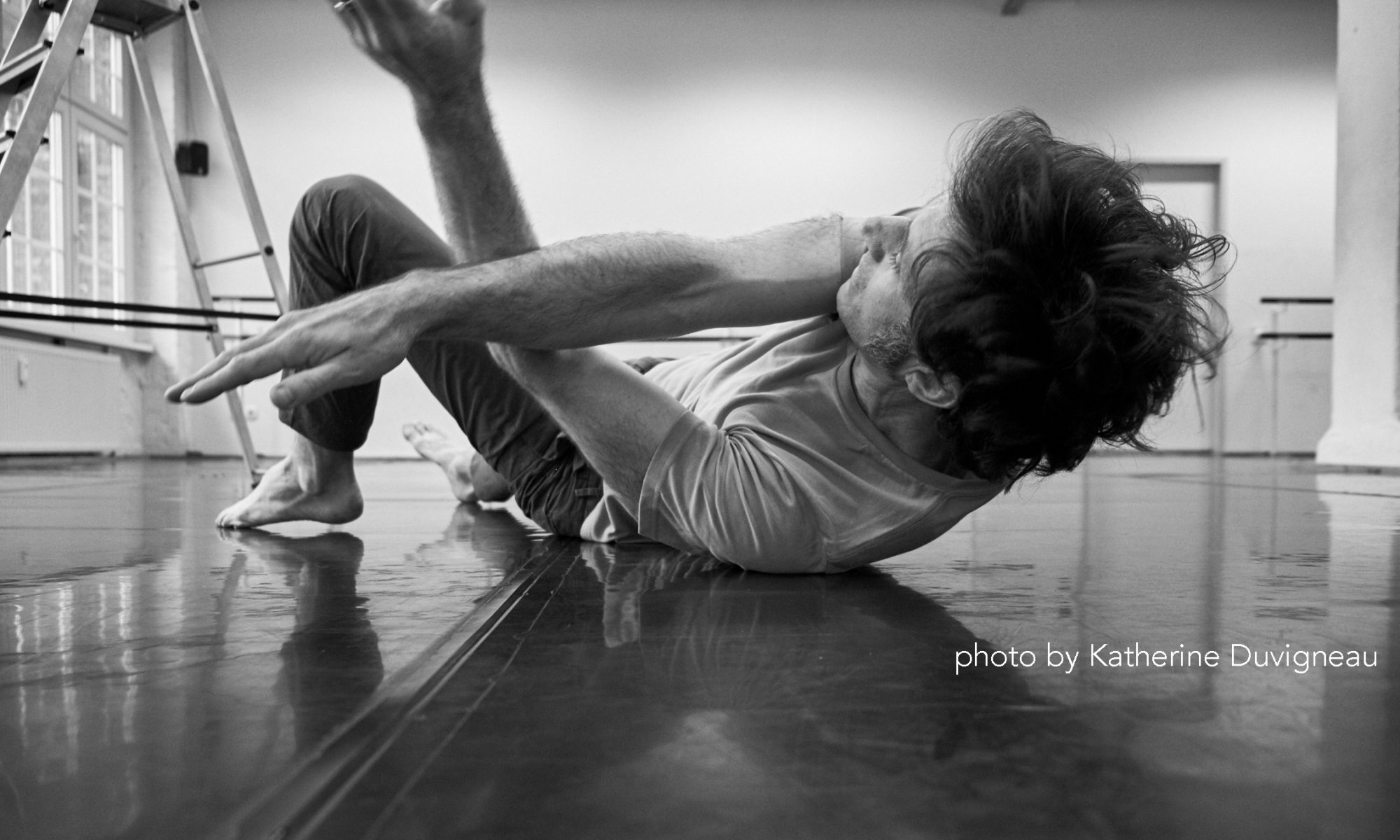
Sentimental Pussyfooting

This is something I wrote to Rita Feliciano, a dance critic in the Bay Area, about my upcoming show, Sentimental Pussyfooting – a study in plagiarism. She was wondering how the show fits into the concept of dance.

“This work fits right into dance. In this show, I am
using works by Yoko Ono, Trisha Brown, John Cage, Jess
Curtis and Paul Taylor as points of departure.

The idea behind the show is to use structures that
have been created by and are attached to specific
artists and re-use/reclaim/re-examine them. The way I
see it dance, or most dance, has the same structure.
Lights go on, music and movement start. It’s
essentially the same skeleton every time. Whether
it’s ODC or Scott Wells, the skeleton is the same.
Just the meat around the bones has changed. The
costumes are different, the music is different etc.
But still essentially the same piece. Or is it?

The piece by Yoko Ono that I will be examining is her
“Cut Piece”. First done in ’64, she sits on stage and
audience members come on stage and cut her clothing.
In my show I will do this piece again. I will sit on
stage, audience members will come on stage and cut off
my clothes. Some people will say that I am doing
Ono’s piece again. But am I? The scissors are
different, the clothes, the audience, the location,
the pathways cut into the clothing will be different.

If ODC and Scott Wells are different pieces then Ono’s
piece and mine are different. In both cases, the
costumes are different. The people executing the
movements are different. The pathways of the bodies
and scissors are different. The lighting is
different. The soundscore is different. Yet the
skeleton remains the same.

People are more likely to say that I am repeating
Ono’s piece because it is a different enough of a
skeleton from the basic dance skeleton. No one says
to ODC or Paul Taylor – “Oh lights, movement, and
music…that is So and So’s piece” Why not? Because
that skeleton is from time immemorial. And most dance
I see is just repeating the same skeleton over and
over again. And dance is so rich because we keep
investigating the same skeleton over and over again.
Where would dance be if people stopped making dances
to music because that had already been done?

By keeping certain structures identified with certain
artists, the collective artistic investigation is
limited. By saying – Oh we can’t do that because that
is So and So’s piece – we cut ourselves off from so
many possibilties. Every piece in this show that I am
relating to, I consider a door that was created when
the pieces were originally made, a door for us to walk
through. Those artists pointed us in new directions.
It is up to us to continue in those directions and
continue their investigations.”

Review?

Wendy Perron, the editor of Dance Magazine, wrote something on her blog about our performance Friday night, Nov. 30th, at St. Mark’s in NYC. Not exactly a glowing review of our work, and I think it perpetuates some bad expectations of improvisation, but still got my name in virtual print by the editor of Dance Magazine.

“Andrew Wass…willing to start his own trouble”

Ten Chi

Last night saw the piece Ten Chi by Pina Bausch. Almost three hours long…professor and Maryanne… Anyways. Some sections I really enjoyed- the grunting woman killing the pillow; the rubbery sinewy solos (ooh, palindrome!!) by the men in black; the incessantly falling flower petals; the Asian woman sweeping across stage supported by two men. Maybe those sections stood out because the rest was not so captivating.

What was the point of the show? What was the connection to Japan? The piece was funded in part by a Japanese governmental agency, I think. A little something I read in the program, (which could have had a bit more in it to shed some light on performance). Many references to Japan – My car is Toyota, my TV Sanyo, my VCR Samsung…; the tour guide with the backpack; the whale on stage; the bowing section between two women.

The piece was constructed of short vignettes, some dancing, some talking, occasionally a woman in a silk dressing gown was lifted by a large blonde man, a pillow was thrown, a pillow was killed, various ways to wear a white handkerchief were modeled, men were carried on stage and their hair stood up, a woman had her dress ripped off, a man lifted a woman and carried her around the whale tail while she mimed swimming (VERY CHEESY!!), an Asian dwarf came on stage riding an ostrich, well no that did not happen but if it had, it would have fit right in….on and on these vignettes came and the snow/flowers/dandruff fell.

I did not understand the point of all these vignettes. Were they impressions of Pina’s time in Japan? I could not sense an arch, but I could an overall structure. In 3 hours she had plenty of time to create one. First a dance section, then a talking section…this is dance theater after, must have talking. It was a 3 hour variety show, that ended with a dance off – each of the performers showcasing their skill to loud music. The crowd roared and leaped to their feet. Why, why, why, why, why?

final though:
Let us not confuse budget with genius

Contemporary dance

Well, I guess there is a definition of contemporary dance. Not sure how reliable that definition is and not sure how good of a term “contemporary dance” is. Definitions that are related to time are tricky. What is after contemporary? Post contemporary? People should drop the time aspect and give dance a name that explains what it is. Contemporary doesn’t define anything but time – when it happens/happened. In the definition yoga is part of contemporary dance and yoga is 5000 years old. Yes, it is just one of the things drawn upon. Contemporary dance, maybe should be called “and the kitchen sink dance” because everything is fair game.

How many of those things does one need to incorporate to be a contemporary dancer? If I just use Horton, Hawkins, Cunningham and Humphrey does that make me contemporary? No! Cunningham is the most recent and he hasn’t been contemporary since the 60’s. Okay, they used Ipods. Making a man a priest makes him neither celibate nor honest.

Couldn’t someone use tap and be “contemporary”? Or how about square dancing? Is that not contemporary? I am sure people are creating new square dances all the time. And ballet? New balletic movement is created all the time. Not sure how long it takes before some moves join the canon of ballet.

This definition is another instance of people valuing the tool over the logic or aesthetic. Dance is so much more than techniques about the body. Dance is the art form that uses the body to address various logics (stories, topics). The more I think about the term “contemporary” the more I dislike it. I have contempt for contemporary. Vague, vague, vague.

“What kind of dance do you do?”
“Oh, I do ‘of the present time’ dancing.”
“Interesting”

Labels, labels, labels…we do need them.

Culture vs. Entertainment

Something I wrote a while back, Jan 25th 2005, and was thinking about again recently…

“…leads into my questions of audience. Why are they here? Entertainment, investigation expectation? Do they want to be challenged? If your expectations are not met then do you feel disappointment? But then if you as audience have expectations do we (the performers) need to be there? The audience could pay their money and just sit there and imagine the whole thing.

To be simplistic about it, there are two types of audience members. Those who go to a show with a certain amount of or with expectations. And there are those who go to a show with no expectations at all. But if you have ever seen an artist’s work before, it is impossible to go to their show and not have some expectations of what the show will be like. That is why people go back and see certain artist’s work again. The previous experience was satisfactory in some manner. The audience enjoyed themselves on some level.

This brings in the question of enjoyment. Do you enjoy having your expectations met? or contradicted/contrasted? Do you want your world view challenged or reaffirmed? Do you want recognizable elements, quotidian events re/arranged related in a suprising manner? Do you want to see something completely unrecognizeable that you cannot relate to at all? Do you come here to be offended? Do you come here for cultural edification? Or is it pure sensational masturbation?

Some might say that the opera, the ballet, the symphony are signs or events of high culture. Of higher value than a baseball game, a monster truck rally, or a wet T-shirt contest. But not the events in and of themselves are important but how the audience members relate to the event is important; is what makes them of cultural import. At the truck rally, people go to hear the roar of the engines, the smashing of the cars to see the huge trucks fly through the air and land or flop over.

At the ballet people go to hear the orchestra and see the lithe ballerina fly through the air and land in the arms of her partner. But @ either event the audience knows what is going to happen. They know the elements that make up the spectacle. They, the audience, are there to satisfy a certain desire, to fulfill an expectation. What would be more of a cultural event is is the typical ballet audience member went to the truck rally and the Nascar Dad went to the Lincoln Center to see the American Ballet Theater retrospective etc. Does the audience want to hide?”

My main point of something being cultural or not is the relationship between the audience and the material. If the audience is going for fulfillment then all events are of the same cultural value – sensational masturbation as I wrote above. If the audience is going to expand its horizons, that is culture.”