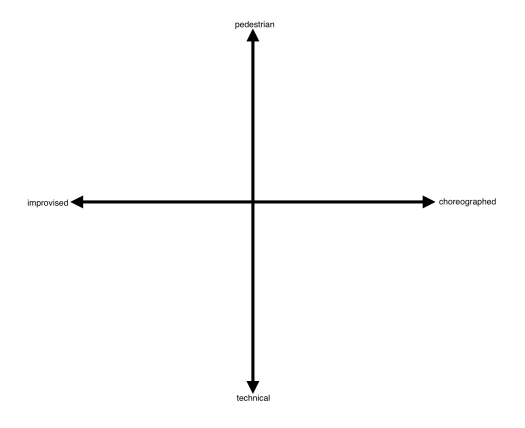
Is CI a Cunningham chance operation?

‘The dancers are called on not to express a particular emotion, or set of emotions, but instead to develop refined coping mechanisms for creating continuity between disarticulated movements while remaining sensitive to their location in space. They must keep time without musical cues; sense the presence of the other dancers on stage; know blindly proprioceptively, what these other dancers are doing; and adjust the the timing and scope of their movements accordingly, thereby expressing the “human condition” at hand. All this work is “expressive”-it belongs to the “category of expression”-insofar as it is demanded by a human situation on a stage and insofar as human situations on stages (or otherwise) constitute an embodied response to the present moment, an embodied response to the utterly unique conditions of existence at one given point in time.’ – Noland, C 2010, ‘The Human Situation on Stage: Merce Cunningham, Theodor Adorno, and the Category of Expression’, Dance Research Journal, 1, p. 55

In this quote, Noland is referring to Cunningham dancers dealing with the re-ordering of set phrase material.  When she writes (or otherwise), she could be referring to a contact improvisation jam.  I think it is a very apt description of an silent CI jam. In CI jams, dancers are constantly “using refined coping mechanisms for creating continuity between disarticulated movements while remaining sensitive to their location in space.”  [Though, how much contacters are actually aware of the whole space is open for debate! IMHO]

What people do at CI jams is, I would say, “an embodied response to the present moment, an embodied response to the utterly unique conditions of existence at one given point in time.” [Though, how much is actually an embodied response and not actually another iteration of habit is also open for debate. IMHO]

Are Cunningham choreographies that are governed by chance operations a contact improvisation jam?

Are contact improvisation jams a piece of choreography by Cunningham?

Paxton danced for Cunningham, after all.
Heart and Soul

Paraphrasing Schuller and Duke-

‘”Improvisation is the heart and soul of [contact improvisation].” However, [contact improvisation] is not the heart and soul of improvisation, and they are definitely not one and the same.’ – John Henry Duke, Teaching Musical Improvisation: A Study of 18th and 20th Century Methods, pg. 16

Channeled Consciously

“The meaning for me is the truth involved in this: one artist creating spontaneously something which is governed by the atmosphere, the audience, the place (both the room  and the geographical location), the instrument; all these being channeled consciously through the artist so that everyone’s efforts are rewarded, although the success or failure belongs completely to the artist himself.  The artist is responsible for every second.

In a group this is not true, nor should it be true.  One is firstly responsible to the other players and so the cycle is not quite complete, not quite pure.  Nobody knows exactly whose fault or responsibility, failure, or success it is because of the nature of a group and the complexities involved.  One does not have the communion with the audience because one is having communion with the rest of the group.” – Keith Jarrett, from the liner notes for Solo-Concerts Bremen Lausanne

Today I bought Keith Jarrett’s Solo-Concerts Bremen Lausanne CD.  I don’t know much about his music, haven’t heard much of it.  I listened to a story a few days ago on, I think, NPR about the album of his solo concert in Cologne and then walked by the Dussmann shop on Friedrichstrasse and saw several of his albums for sale.  Couldn’t find the Köln one, so I bought this one.  Listening to it right now, the part from Lausanne.  Around 23:00 some great music happens and continues to about 29:00.  A wonderful vein that he explores.

I really like some things he says in the above quote –

  • something which is governed by the atmosphere, the audience, the place (both the room  and the geographical location), the instrument
  • channeled consciously through the artist
  • Nobody knows exactly whose fault or responsibility, failure, or success it is

What I like the most is the word consciously.  Too often, I think, people associate spontaneous and improvised with unconscious.  I have no interest in watching someone who is unconscious.

Something I don’t agree with or don’t understand is the success or failure belongs completely to the artist himself.  The artist is responsible for every second.  I do not believe that the success or failure of a piece lies completely with the artist.  The artist can’t know what the audience likes and doesn’t; knows and doesn’t know and, I would say, can’t be held responsible for the success or failure of a piece.  Well, in his or her eyes/ears/mind, yes, but not in the audiences.

But the artist is responsible for every second because s/he is the one active agent in the artist-audience relationship.  Maybe active is the wrong word.  Maybe expressive in that the artist is putting something out and the audience is absorbing it.  But if we are to take his earlier statement that the atmosphere and the audience govern what the artist is creating then the audience is partly responsible.  Though at the moment of execution, the artist is the one deciding what happens.

What cycle is Jarrett talking about in the second paragraph?  Is he referring to the cycle of atmosphere, audience, etc. affecting the artist who is then in turn affecting the atmosphere, audience, etc which then in turn affect the artist which then in turn…?  So then does the group or ensemble communion affect connection to the audience?  I would agree, and maybe this is why ensemble improvisation can seem insular or self indulgent because the artists are paying more attention to each other than to the audience.  Hmm…, but I am speaking from a dance artist’s perspective and not a music artist’s perspective.

Whatever he means, I’m going to listen to more of his music.

ps: pardon the bad syntax.

The Penumbra of Spatial Apprehension

The Penumbra of Spatial Apprehension

The Penumbra of Spatial Apprehension, the downstage semi-circle shown here in red, is the area of the performance space that the performers, unless required to do so by a predetermined spatial choreography, tend to avoid.

When performers enter this penumbra, they tend to face upstage if vertical; or keep their pelvises close to the ground if facing downstage; or move through the penumbra with a trajectory parallel with the front of the stage.

Experience and the likelihood of entering the penumbra do not have a direct relationship.

Yoga and Improvisation

Below are quotes from the book Yoga and the Quest for the True Self by Stephen Cope.  An interesting read.  These quotes stood out for me as they connected to how I define and think about improvised performance.  Maybe these thoughts will resonate with you, too.

Pg 12 – After a period of intentional disorganization, the self emerges reorganized
Pg 40 – …for I am an immovable cause that moves all things
Pg 42 – We are already inherently perfect
Pg 53 – The dance that results if the interplay of energy and consciousness or what yogis call lila – the divine play
Pg 62 – Unlike your Christian religion, for example, we don’t believe that the problem is sin, or guilt, or wrongdoing.  It’s simply misidentification.
Pg 71 – the text book of immediate experience
Pg 72 – the renunciation of extrinsic sources of satisfaction
Pg 93 – It became alarmingly clear, for may of us, just how much the unconscious sense that “something is wrong” drives our behavior.
Pg 105 – The preoccupying question is no longer, ”What is wrong with this moment?” or “How do I change this reality so that it conforms with my ideals?” but, rather, “What is the nature of this moment-precisely?  How can I examine it more deeply?”
Pg 122 – a nonreactive, nonjudgmental, quality of acceptance…the twin pillars of clear seeing and calm abiding
Pg123 – The mind then becomes an instrument for penetrating into the essence of things, for taking possession of, or assimilating, the real…an instrument of knowing that is nonreactive
Pg 135 – the preliminary practices of yoga are almost all about building the calmly abiding self
Pg 156 – The eyes with which we are seen become the eyes through which we see ourselves.
Pg 178 – “choiceless awareness”
Part 4 – The Spontaneous Wisdom of the Body
Pg 209 – yoga – the practice of being present for experience.
Pg 210 – breathe, relax, feel, watch, allow
Pg 214 – As we become absorbed in the witness, we’re free both to participate in and to stand apart from our experience.
Pg 215 – we must allow the process to happen without necessarily understanding it.
Pg 216 – to notice without judgement
Pg 216 – We can learn to live on the magnificient edge where anything can happen
Pg 228 – three important ways – developing the instruments of proprioception (body awareness), restoring conscious control, to the most refined centers of the brain, and penetrating the deep internal body.
Pg 250 – the mental and physical flexibility to track and adapt to the changing demands and input of the environment on a moment-by-moment basis.
Pg 252 – that yogis experiencing dhyana was primarily attentive to, and occasionally absorbed in, the pure perceptual features of the object of their attention
Pg 255 – “The image of a posture arises spontaneously on the mind.  You wonder if it might happen.  Sometimes it does, following you thoughts; and sometimes it doesn’t.  It is completely beyond your volition.”
Pg 262 – When we have these ideas in our heads of “what is supposed to happen” in our bodies, we very often spend time looking for these experiences and feeling badly or inadequate when we don’t have them.  In the meantime we miss what is really happening.
Pg 266 – to tune out distracting and irrelevant stimuli
Pg 303 – As Robert Frost said, “ Freedom means moving comfortably in harness”

**** Hotel

The third iteration of ***** Hotel will be appearing in a couple weeks, at the GOlive Festival in London.

Sadly only four of the stars will be able to make it.  Down 20% from the inaugural performance, but up 33% from the second performance.

I am interested to see how this latest constellation will perform.  Again with a live musician, this time a percussionist.  The first iteration had a musician who, if my memory serves me, was a bassist who used a kettle drum, a piano and a variety of small hand held instruments.  The musician for the second performance is a cellist, Barnaby Tree.  What intrigues me is the concept of melding rehearsal with performance.  As the members of 5***** Hotel live in four different cities, they are not able to rehearse in the traditional sense.  This geographic variation forces the group to rehearse in front of an audience.

When I performed with Nancy S. Smith, in 2008 I think it was, at SFDI, she told me of a rehearsal process with a group of experienced performers.  They had agreed upon a score, which during the performance they all abandoned.  Granted a score can be abandoned and everything is fine, but then there’s abandoned.  Some performers ended up in the audience, some were singing.  This is not to say that the performance was “good” or not, but I am relating this anecdote to illustrate the fact that when the lights go up and there’s an audience, plans and people change.

With the group ***** Hotel, because there is no rehearsal, there is no possibility of deviation.  Personalities and plans can’t change from the studio time to the stage time.  For me, if we are to use the three stages of creation to define an improvisation, this method of performance making is even closer to an improvised performance.

The moments of execution during the GOlive festival will be very close temporally to the moments of experimentation.  The exploration stage has already been completed as the personnel, the location, the time of the performance, the costumes, etc., and the concept (open spontaneously composed performance) have already been determined.  Looking more closely into the stage of execution, i.e., the performance, what will happen in front of the audience has yet to be determined.  So within the execution stage, the three stages of creation as they relate to the performance, will be constantly evolving and informing each other.

To see how that exactly unfolds come to the Lion and Unicorn Theatre on the 26th and the 27th of this month

Another definition

The choreography of a piece is that which is repeatable between iterations.

The improvisation of a piece is that which is not repeatable between iterations.

Rehearsal Videos

The above are three videos from rehearsals in the Crowley Theater for the third section of Secondary Surface Rendered.  We are investigating the use of repetitive movement drawn from the Re/Wire work to examine and magnify the corporeal kinetic connection between drawing and dancing.