Choreography is knowing the other’s response to your actions.
Improvisation is not knowing the other’s response to your actions
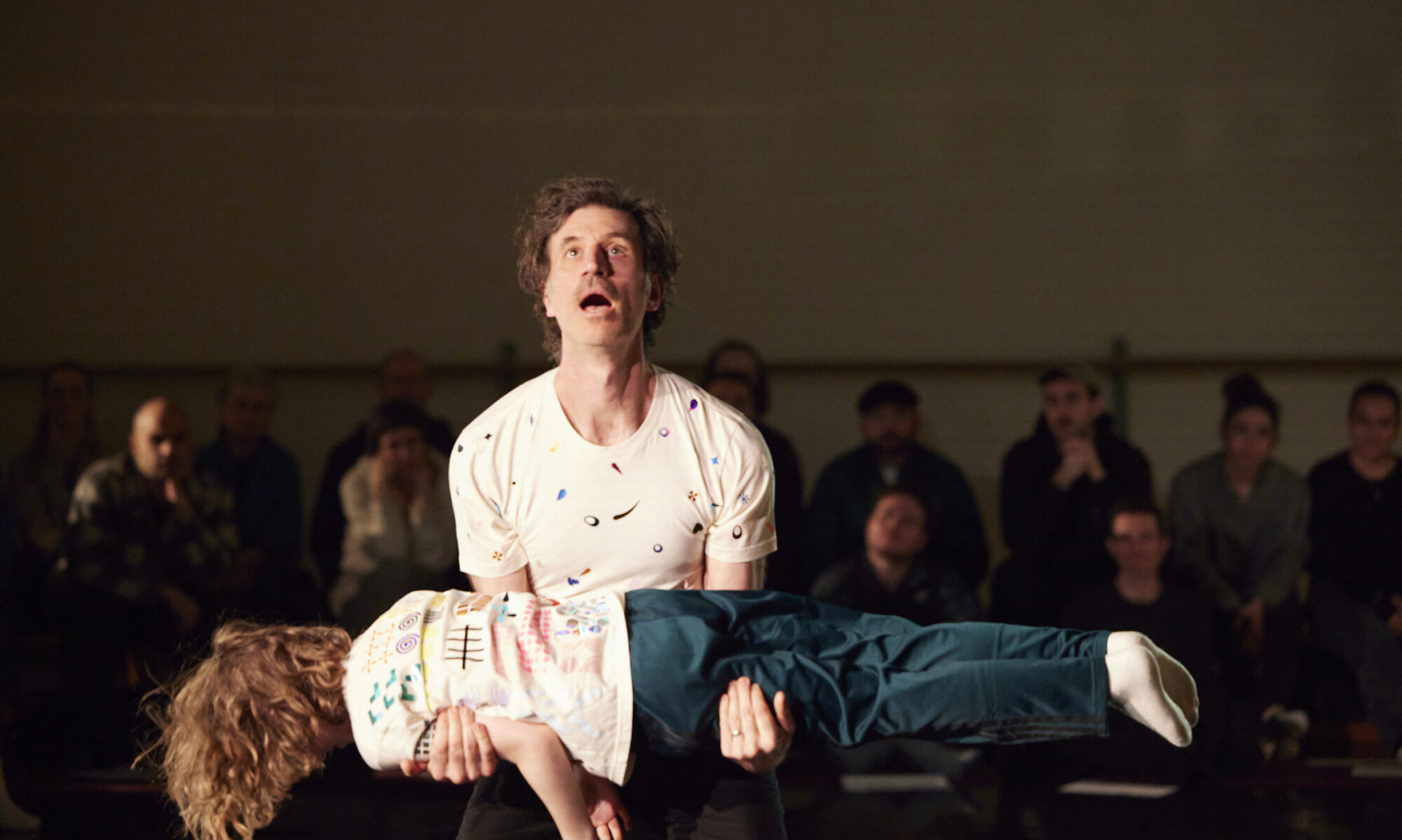
the philosophy of movement
Choreography is knowing the other’s response to your actions.
Improvisation is not knowing the other’s response to your actions
Contact Improvisation has become a dance of the subject, not the object.
discuss
There is no theory.
There is only practice.
What you do is your practice.
Whether you are sitting at a table or lying on the floor or doing push-ups or aligning your heels with your sitz bones or quoting dead lovers of knowledge, you are engaged in a practice. If you are repeating it, you are rehearsing it. If you are rehearsing it, it is your practice. If you are sitting around a table discussing the possibilities of choreography, you are practicing sitting around a table discussing possibilities. Why are you not stretching or sharing weight while discussing the possibilities of choreography?
It has been scientifically proven that those who sit more live shorter lives.
Do you want your practice to lead to a shorter life span?
one article
another article
a third article
This leads me to another point. Philosophy. Philo coming from the Latin for love and sophy from sophia mean knowledge or wisdom. Therefore, someone who loves knowledge is a philosopher. Anyone who is involved in a practice is therefore a philosopher. The more rigorous the practice the more rigorous the philosophy. Therefore anyone who has an interest, whether it’s comic books, ballet, baseball, anatomy, is a philosopher. He or she loves knowledge of a sort. It might not be knowledge that someone else finds particularly useful or valid, but it is still knowledge. Whether Green Lantern could survive an attack by the Silver Surfer is just as philosophical a discussion as an aesthetic and textual examination of King Lear.
A chef is a philosopher.
A soccer coach is a philosopher.
A hair dresser is a philosopher.
A rancher is a philosopher.
An eye doctor is a philosopher.
A second grade teacher is a philosopher.
A Shiatsu practitioner is a philosopher.
A forest ranger is a philosopher.
A stat quoting baseball fan is a philosopher.
A contact improviser is a philosopher.
Something I wrote on the subway today about improvised performance, especially in relation to my project as part of my third semester studies at SODA –
Improvised Ensemble Performance intentionally has such a limited palette in relation to props, music, set etc. as each of those elements and the unnamed ones are all ways that we can distract ourselves from our existence. Think of cell phones, portable music and video sources on planes, trains and automobiles. We use those forms to pull us away from ourselves, intentionally or not. But consciously using the limited (yet infinite!) palette of shape, space and time, we are drawing our own attention to the barest form of our existence. We will not distract you, the audience, from your experience with sound, set, drama, overt story, magic, the space of appearance etc. We invite you, maybe challenge you, to experience what is happening before you.
A couple weeks ago I was fortunate to go to Tanz Plattform 2012 in Dresden. Tanz Plattform is an event that happens every two years. It is like APAP in New York. But as I have never been to APAP, I can’t be sure. The event in Dresden was primarily for curators from festivals around Europe to see work of the who’s who of German dance. Not sure why the who’s who needs an event like this, but that is another discussion.
I was able to go because my school organized a trip. €50 got me a round-trip train ticket, a hostel room and breakfast for four nights and tickets to ten shows. Not a bad deal. Yeah, socialism!
Of the performances happening in five theater in two different location, I was able to see (in no particular order) For Faces by Anonia Behr, Horizon(s) by Laurent Chétoune; N.N.N.N by William Forsythe; Abdrücke by Anna Konjtzky; Berlin Elsewhere by Constanza Macras; Cover Up by Mamaza; Dance For Nothing by Eszter Salamon; Revolver Besorgen by Helena Waldmann; Métamorphoses by Sasha Waltz; and Baader – Choreographie einer Radikalisierung by Christoph Winkler.
Of those performances I would categorize Abdrücke, Berlin Elsewhere, Cover Up, Revolver Besorger, and Baader as theater. Horizon(s), N.N.N.N., Métamorphoses, Dance for Nothing, and For Faces as dance. These categorizations are based upon the rubric that theater is dealing with, referencing or talking about ideas or events that are not present on stage and/or trying to convey an emotional state. Granted this is not a binary, but more of a spectrum.
But definitions of theater vs. dance are not what I want to write about right now. Again, another lengthy discussion.
What I want to write about is several sentences in the programs about these specific performances or work by one of choreographers in general:
1. “Dance is no longer representation.” – Laurent Chétouane
2. “Chétouane makes reference to classical dance forms and formulas and dares to come out from the corner by demonstrating how dance beyond style – the dance of the future – might look” – Katja Schneider
3. “Forsythe embarks on a search for a quality of movement that is increasingly oriented towards the dancers’ own self awareness and reciprocal observing of one another, generating an intense presence in the space.” – Gerald Siegmund
4. “Movement without reason(s) makes the audience nervous….a clear, deep and melodious voice, sharing philosophical introspections, while the source steadily changes positions – we try to follow it all. Yet, it is too much to process all at once, form and content at the same time.” – Katja Werner
5. “Helena Waldmann… the Berlin-based choreographer…knows that a work is only successful when it is able to conjure up the world of illusion.” Andrea Kachelreiß, Stuttgarter Nachrichten
I am not sure how to respond to the first sentence by Chétouane. Dance hasn’t been representation for decades. Did he not get the Judson/Trio A/Merce/Brown memo? He is described as “a French director working with texts and movement” so maybe he is not informed about what dance has happened before he started making dances.
This seems to me a common issue in the post/non disciplinary times – people from one genre getting excited about a new tool, logic or aesthetic that is old hat for another genre. Maybe because Chétouane is a director, which I am taking to mean he comes from the world of theater, the world of illusion and allusion, the idea that something on stage could be no longer representational is a new and exciting one.
The second sentence, by Katja Scheider, I also think is a joke. Dance beyond style?!?! Dance of the future?!? Are you kidding me? What I saw was pretty straight-up, par for the course movement for this day and age. Does Katja mean that the dance of the future looks just as it does now? Are we already in the future or is she saying that there is no future for dance because it will look exactly the same as it does now? There is nothing nothing new in the world…is that it?
The references to “classical dance forms and formulas” that I saw the grid, flocking, and mirroring. Maybe not classical ballet formulas, if that is what Katja Schneider meant by classical, but classical post modern dance tools. At least for grid and flocking. Mirroring is more of an Improv 101 exercise, so maybe classical in that sense. But maybe that is what my training affords me – seeing the grid, flocking, and mirroring. If I am to look at the piece as a whole, and this is the second time I have seen the piece, I could say that the piece is an arc of dance history from ballet to post modern spatial scores to badly executed contact improvisation. Maybe that is the director’s point, that the end of the future(as this piece is about the future of dance) of dance is bad contact improvisation. Well, if that is the point of the piece, then it’s brilliant. Sheer brilliance. Ha!
Gerald Siegmund’s description of Forsythe’s new creative invesigations is interesting and eloquent. Hmm…sounds an awful lot like…what is that word, umm, it was just on the tip of my tongue, what is it…oh, yeah…IMPROVISATION! Why is that word such a dirty word? I guess a single word wouldn’t be as poetic as an eloquent phrase. I guess a rose by any other name doesn’t smell as sweet.
Categories and labels aside, I have another question. What was Forsythe’s work before this new eloquent line of inquiry? Did his work before not use “the dancers’ own self awareness and reciprocal observing of one another”? Were his dancers unconscious of their own movements and and unaware of each other? Did they not know where their limbs were in space? Did they not know who else was on stage and who on stage could see them? Were his dancers mindless zombies doing their master’s bidding?
On what planet does “movement without reason(s)” make the audience nervous? Maybe Katja Werner is from the same planet that Chétouane is from, the Planet of Representation, where Judson never happened. I thought that the crowd at Tanz Plattform Deutschland 2012 in Dresden would be ok with abstract movement. Guess not. But they seemed to love N.N.N.N., which was pretty abstract. Granted the dancers looked at their hands as they moved them, creating a subject by objectifying their hands, and made cute sounds as they moved. Maybe the looking at the vocalizing created enough “reason” so that the audience was not nervous. They could see enough representation in the presentation of relationship between hand and eye and movement and sound, therefore they did not get nervous.
On the Planet of Representation form and content are two different things. Performances have content and that content is different than the form. This leads me to another definition of theater and of dance. Theater is that which the form and the content are different entities. In dance the form and the content are the same entity. In the piece Dance for Nothing by Salamon, I think that Werner is referring to the spoken text as the content and the “movement without reason(s)” as the form. This separation is further evidence of the supremacy of theater over dance in Germany. Tanztheater, Tanztheater, Tanztheater, TanzTHEATER. Tanz is merely the adjective to the noun, theater.
I would postulate that the reasons Werner writes that the form(movement) and content(text) is “too much to process all at once” are that she is not a native speaker of English and she is trying to link the movements to the text in more than a spatial and temporal way. From the beginning of the piece I did not try to connect the movement to the sounds. I let both of them wash over me. Even though I am a native speaker of English, I would guess that the text by John Cage is not that complicated. The vocabulary and the topic are not that esoteric to require a super advanced command of the English language. Most people at the festival in Dresden had very good English.
Or maybe I was a bad audience member and did not listen closely enough to the text, did not get every word and would fail a test on what John Cage via Eszter Salamon said. Maybe I should have strained harder to understand which movements meant Kansas, paragraph, and mind. Maybe I should have asked why Salamon extended her fists and touched them together. Did that movement section represent a connection of the working class in Kansas to the proletariat of Hungary? Hmm…what would Derrida say about the fact that the performer wore sneakers? Oh my gosh, so many signs and signifiers, so many layers…how do I interpret it all? What does it represent?!?!
And the final quote – “to conjure up the world of illusion”. Once again, theater, theater, theater. Yet the author of this work is referred to as a choreographer. There is a fabulously trained ballet dancer prancing about pretending to be a crazy woman who has a “thirst for discovery” and is in “the depths of madness”, so I guess it’s theater because the piece is about something other than what is happening on stage. But the creator is a choreographer and not a dancer.
Kachelrieß writes that Waldmann’s work is a “godsend for the theater.” Does she mean theater in the open sense of the word, as in stuff that happens in the theater? Or does she mean theater as in not dance? If she means theater, then this piece is a vague and wan representation of an illusion wrapped in presentation of madness and the “dignity a person needs to remain human.” But if this piece is dance, then it is well danced dance piece of a limited and unimaginative palette.
I do not know what my overall thesis for this posting is. Maybe that dance in Germany is more theater than dance.
Tanztheater.
I prefer my dance with a little less theater and a lot more dance.
What humanity needs to ingest to survive evolves very slowly. As our ancestors before us, we are still eating proteins, sugars, fats, vitamins, antioxidants, etc to survive. Humanity’s needs in the arts evolve slowly, too. Witness the fact that Greek tragedies and Shakespeare’s plays are still produced. Song of love and loss are recorded still. Instead of using harps, musicians now use laptops and keyboards.
What evolves faster in terms of performance ingestion is the tools used to create the fodder for consumption. New ways of moving, making sound, lighting the performance space, modes of covering and leaving the performing form uncovered evolve faster than what is done with those tools.
Inevitably these new tools are used to in performances that return to the basic needs of the audience. After a deplorably short time, the exploration of the new tools is dropped and their use is co-opted by the need to explore the human condition, to create theater.
In other words, the tools and aesthetics change, but we come back to the same logics again and again and again.
Just as the nutritive needs of human will basically remain static so, too, will the performative needs of humanity. It, therefore, behooves us to investigate the tools themselves and not their use in relation to humanity and the human condition. Only in this way can we expect the arts to evolve
Having a diverse cohort has its advantages and disadvantages. An advantage is that people from different backgrounds can see my work in a new light from a different perspective and offer me feedback from that perspective. A disadvantage is that they do not know as much as I do about my tools/genre, as I know little about theirs.
By having such surface knowledge about their media, I am not able to push them more in their direction. Yes, I can offer “lay” opinions in their work and shift their progress(maybe) but if we all are continually helping shift each other, will we be able to get anywhere or will we just cover the same ground erratically?
A bunch of blind spiders creeping around the same dusty shoe box? Milling about getting nowhere…
Does this continual redirection prevent us from progressing forward in relation to ourselves not just in relation to the opinion of an outsider?
The port de bras and the coolest new lift you just learned in contact class have just as much to with contact improvisation as the fist bump. All three can be done while in contact and while improvising.
All three events are small bit of choreography that can be done inside the larger frame of contact improvisation.
The more closely linked an event is to memory, the more choreographed it is. The less connected to memory, the more improvised it is.