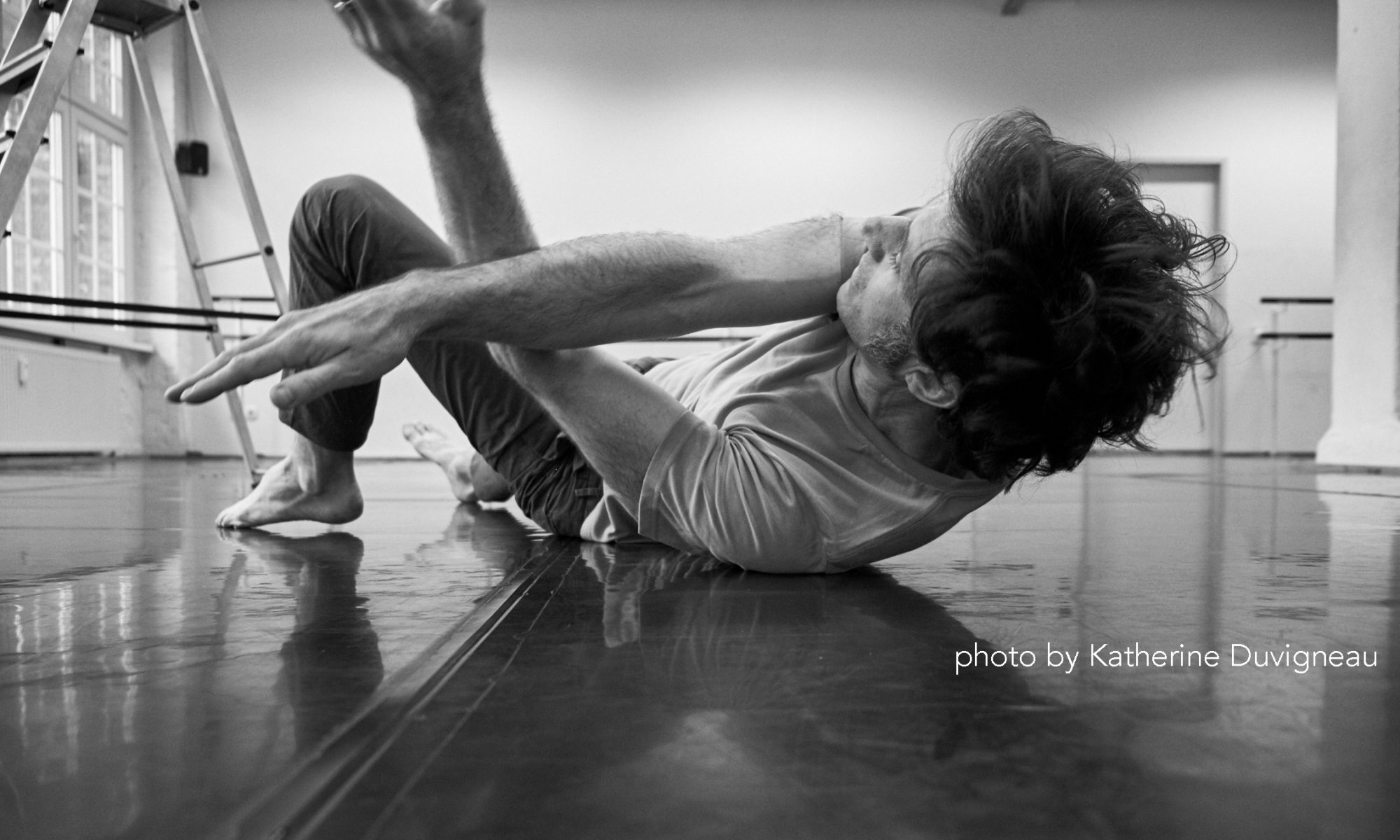
hypothesis – Flow is not a dance but a safety measure.
Surrender
When, through your practice of Ensemble Thinking, Viewpoints, Action Theater, and Contact Improvisation, you have reached a higher state of intelligence, and that mature intelligence makes you lose the identity of the self, you become one with the performance because you surrender yourself to improvisation.
When, through your practice, you have reached a higher state of intelligence, and that mature intelligence makes you lose the identity of the self, you become one with God because you surrender yourself to Him. This is Isvara-pranidhana, surrender of one’s actions and one’s will to God. – pg 53, Tree of Yoga by BKS Iyengar.
**** Hotel
The third iteration of ***** Hotel will be appearing in a couple weeks, at the GOlive Festival in London.
Sadly only four of the stars will be able to make it. Down 20% from the inaugural performance, but up 33% from the second performance.
I am interested to see how this latest constellation will perform. Again with a live musician, this time a percussionist. The first iteration had a musician who, if my memory serves me, was a bassist who used a kettle drum, a piano and a variety of small hand held instruments. The musician for the second performance is a cellist, Barnaby Tree. What intrigues me is the concept of melding rehearsal with performance. As the members of 5***** Hotel live in four different cities, they are not able to rehearse in the traditional sense. This geographic variation forces the group to rehearse in front of an audience.
When I performed with Nancy S. Smith, in 2008 I think it was, at SFDI, she told me of a rehearsal process with a group of experienced performers. They had agreed upon a score, which during the performance they all abandoned. Granted a score can be abandoned and everything is fine, but then there’s abandoned. Some performers ended up in the audience, some were singing. This is not to say that the performance was “good” or not, but I am relating this anecdote to illustrate the fact that when the lights go up and there’s an audience, plans and people change.
With the group ***** Hotel, because there is no rehearsal, there is no possibility of deviation. Personalities and plans can’t change from the studio time to the stage time. For me, if we are to use the three stages of creation to define an improvisation, this method of performance making is even closer to an improvised performance.
The moments of execution during the GOlive festival will be very close temporally to the moments of experimentation. The exploration stage has already been completed as the personnel, the location, the time of the performance, the costumes, etc., and the concept (open spontaneously composed performance) have already been determined. Looking more closely into the stage of execution, i.e., the performance, what will happen in front of the audience has yet to be determined. So within the execution stage, the three stages of creation as they relate to the performance, will be constantly evolving and informing each other.
To see how that exactly unfolds come to the Lion and Unicorn Theatre on the 26th and the 27th of this month
*** Hotel
another version of ***** Hotel appeared in Budapest this past summer at the International Improvisation Festival in Budapest.
Seven Thirty in Tights
Seven Thirty In Tights
April 28th 2013 at Sophiensaele
“Picture the ballroom dance of the future. Imagine this dance and its consequences are the result of an intense physical dialogue between dancers – an interaction of distinct group decisions in which all react to the impulses of the others and have to find answers in a split second. Now imagine this dance was a political practice.” – from the program
I saw another piece by Frédéric Gies several years ago and I had the same problem with this one as I did that one. He adds too many other elements to the stage space that the physical actions lose value or I can’t tell what he values about them. The last performance had explicitly stated BMC exercises paired with music by Madonna and a large rug like object hanging from the ceiling upstage. I don’t have or remember the program notes from that piece, so I can’t say what Gies’ goal was in juxtaposing those elements together.
With this piece, he wants us to picture the ballroom dance of the future. The dance we see is a group tuning score about decision making and reacting to others, i.e. improvising. By asking us to view a type of event that is very much of the present (group improvisation) as the ballroom dance of the future, is he saying that in the future scored group improvisation will be a rigid codified form of dance. Looking at another form of group decision making and reacting, the contact improvisation jam, we are well on our way. Contact Improvisation is all but a codified social dance with defined movements and roles. But Gies and company were not engaging in contact improvisation, at least not in the normative sense of contact improvisation. But as they were improvising and coming in and out of contact, the performers in Seven Thirty In Tights could be viewed as engaging in contact improvisation. After all who determines the tools used in a performance – the doers or the viewers?!!?
For me this piece suffered from a flat ontology. All elements had equal value. The physicality didn’t change that much through out the 60 minute plus. The dancers came in and out of manual contact, dancing alone or facing each other. There was some change in tempo, initiated mostly by the female all dressed in red. Well, maybe the elements didn’t have equal value, but I felt that there was so much sensorial noise generated by all the non-dance considerations of the piece, that I couldn’t help but be preoccupied by wondering about the reasons for those elements, thus lowering for the valorization of the corporeal elements. I tried to enjoy the physical actions of the performers (and there were some well trained people performing whom I have enjoyed watching in other performances) but I couldn’t get past the neon lights, the costumes, the tape on the floor, and the program notes.
The physical practice in the piece was not of the future, so maybe the tights, the lights and the tape indicating the 4th wall are elements from the future. But colored fluorescent tubes (a possible Flavin reference?), non-proscenium stage spaces and tights are also not of the future. So is it then the combination of group real time spontaneous composition with the, lighting, costuming, and staging that create the ballroom dance of the future? Or is it up to us, the viewers who have read the program to picture the dance of the future, inspired by the elements presented? (Representation, once again rears its ugly head!)
Another element of the program statement that lowered the valorization of the corporeal elements of the performance was the directive to imagine the dance as a political practice. I felt that in order to do that more fully and in the direction that the choreographer intended I should have attended the lecture by Sylvie Tissot that took the day before I attended the performance. Was this piece a political practice because it was more improvised than choreographed? Was this piece a political practice because the individuals were able to make their own decisions within a larger set of considerations? Political because tax dollars are supporting the work? Who determines the politics – the doers or the viewers?
In summation – I did see some dancing I enjoyed[*], solo body and group, but the staging and sartorial choices were too aesthetically noisy overwhelming the dancing itself. The program notes were too generic and could be applied to any dance, performance, or sporting event for than matter. Maybe instead of generic, I should say open. But for me the program notes/framing/contextualization were way too open. Isn’t part of the artist’s job to focus our attention?
[*]When the group rotated through space along the perimeter of the performance space delineating the boundary between audience and performers.
When the group came to a long diagonal…Doris Humphrey is right!
When in a long line the dancers changed location within the line.
Compare and Contrast
[youtube http://www.youtube.com/watch?v=8pqhks1Q41g]
and
[vimeo http://www.vimeo.com/62056892 w=560&h=315]
granted, it could be said that we are looking at apples and oranges as one performance has audience on three sides, live music, and video. But I would say that these two performances are more alike than they are different. I am most interested in the spacing, placing, and pacing of the kinespheres and how they differ in the two pieces.
Technique trains instinct
Another definition for Contact
Con –
1. a prefix meaning “with,” “together,” “in association”
2. a verb meaning “to commit to memory” or “to study or examine closely”
3. an adverb meaning “on the negative side” or “in opposition”
4. a verb meaning “swindle”, “manipulate”, “persuade”, or “cajole”
Tact –
1.a keen sense of what to say or do to avoid giving offense; skill in dealing with difficult or delicate situations.
2.a keen sense of what is appropriate, tasteful, or aesthetically pleasing; taste; discrimination.
3.touch or the sense of touch.
2.a keen sense of what is appropriate, tasteful, or aesthetically pleasing; taste; discrimination.
3.touch or the sense of touch.
CI is like Champagne
Only bubbly white wine
that comes from the region of
Champagne, France
is given the name
champagne.
Contact Improvisation, some people maintain, is more than just a physical practice. It is a political movement, a way of life, a way to interact with our fellow humans and the world. Some might even go as far as to say CI is a social modality that can change the world.
Contact Improvisation was not created in a vacuum. It arose in the United States during a time of great flux and change. It was a time of great social and political upheaval. Therefore, the environment in which CI arose is inherent in the form.
If CI is a political/social/gender/economic etc. movement then to truly understand CI one has to come from the same soil that birthed CI.
Are, then, only denizens of the United States of America fully capable of understanding CI and manifesting true corporeal self-determination in the moment?
(it could also be that all the concomitant -isms that people attribute to the physical form of CI have nothing to with it, that it is purely the physical practice and form. Yes, CI can be a tool for creating those -isms, but it is not those -isms. A hammer can be used to build a house, but it is not a house.)
A defintion
Improvisation: bodies manifesting and dissolving dynamic temporal-spatial structures according to aesthetic and physical potentialities and proclivities in a planar arena.