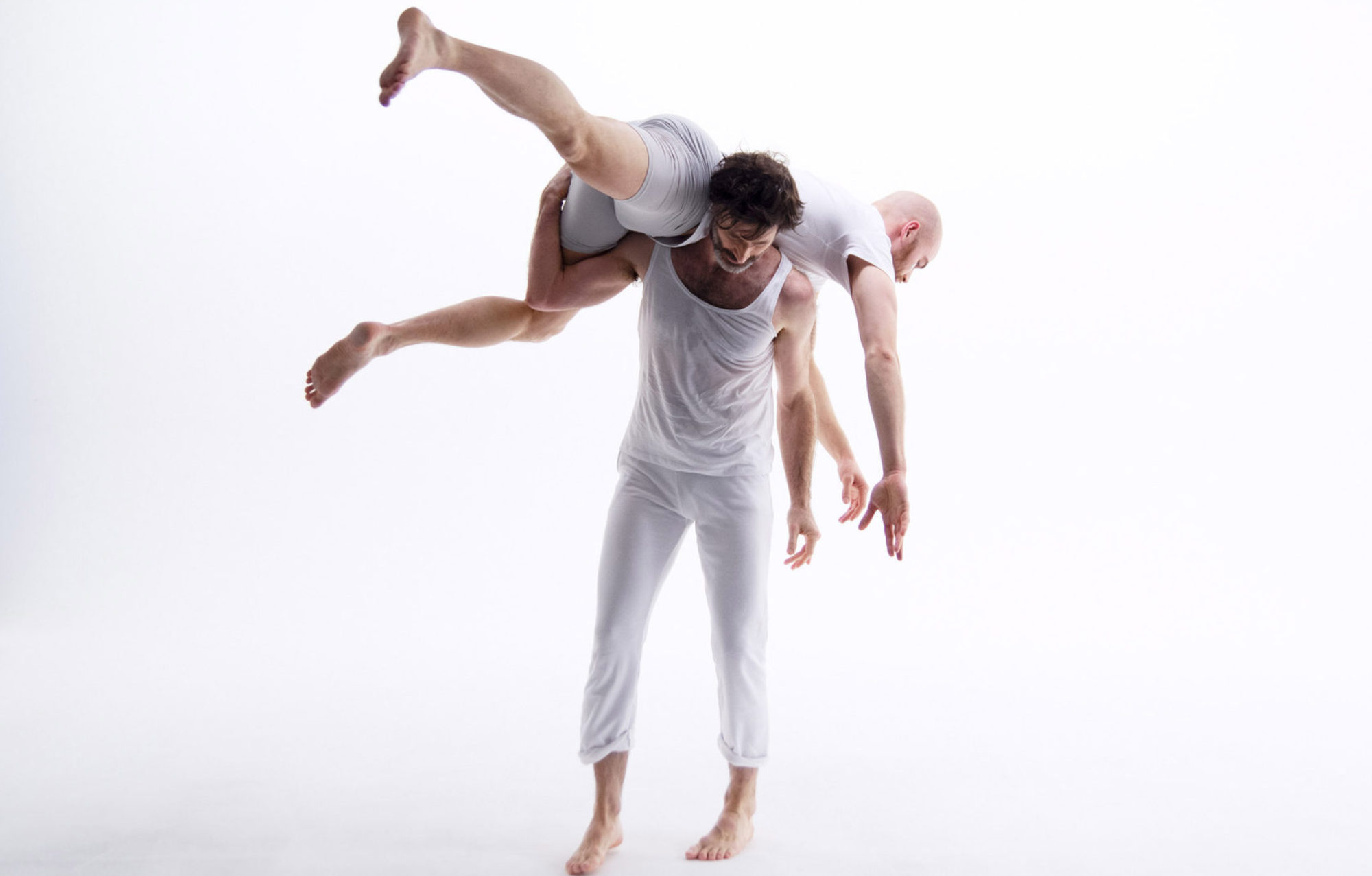
Another definition for Contact

Con –
1. a prefix meaning “with,” “together,” “in association”
2. a verb meaning “to commit to memory” or “to study or examine closely”
3. an adverb meaning “on the negative side” or “in opposition”

4. a verb meaning “swindle”, “manipulate”, “persuade”, or “cajole”

Tact –
1.a keen sense of what to say or do to avoid giving offense; skill in dealing with difficult or delicate situations.
2.a keen sense of what is appropriate, tasteful, or aesthetically pleasing; taste; discrimination.
3.touch or the sense of touch.


A defintion

Improvisation: bodies manifesting and dissolving dynamic temporal-spatial structures according to aesthetic and physical potentialities and proclivities in a planar arena.

Theater vs. Gallery or What vs. Where

If a dance piece is different in a theater than in a gallery, white box vs. black box, how would it change in a movie theater?
in an elementary school theater?
a high school theater?
a college theater?
the art gallery next to the black box theater at the college?
at a theater at a university, a university without a dance major?
in the theater of a university?
in the theater of a PAC 10 university?
in the foyer of that theater?
in the bathroom off the foyer of the theater of the PAC 10 university that doesn’t have a dance major?
in a bus stop near that university?
the bathroom at that bus stop?
the bus that just left the bus stop?
the bathroom on that bus?
the Wendy’s that bus stops at 3 hours later?
in the parking lot of the gas station?
next to pump number 3?
next to pump number 7 that Henry in a red and green plaid shirt is using to fill his Toyota Tundra’s tank?

OK, forget all that.  Let’s go back to a traditional performance space.

A sprung bamboo floor on a 15×10 meter rectangle of concrete with radiant heating.  The concrete is 20 cm thick.  Surrounding the dance floor is gravel.  This floor is in a room that has 5 other such floors and each one is surrounded similarly by gravel.  This room has windows on the north and south sides and has an arched roof. The walls are white; the gravel grey; the ceiling silver.  The east and west sides have brown sliding door 4 meters long and 2 meters tall.  Each door has a cement landing and benches.

Maybe this isn’t a traditional performance space, but my dream studio.

OK, back to this piece…hmm…how about this – We, in the performance world, shall never make a new piece ever again, but agree upon 1 piece that we will all repeat in different contexts.  Never again will we have to worry about what we will do.  The only question is where we will do it.

P.S.
There are an infinite number of contexts (as there are pieces).
I’d rather make the pieces than the contexts.

Personnel vs. Content

I was just at the Texas Dance Improvisation Festival this past weekend.  Thoroughly enjoyed myself.

Sitting in on a class taught by a friend and fellow Lower Lefter, Leslie Scates, I listened to the discussion at the end of class.  One of the participants brought up the question of personnel vs. idea during the exercise of Number Score.

Usually, during Number Score, the content happening in the work/performance space changes when the personnel/dancers change.

This need not be.

How to train Number Score to focus on shifting personnel but maintaining the content?

Does Number Score inadvertently simultaneously train Jump Cuts?

How to train Number Score and not drop material?

Maybe beforehand determine what the material/content will be…

must investigate (though, I have always had trouble with Number Score.  Not that I think it is a pointless exercise.  I see its value, but I have (almost) never enjoyed it)

European English

Due to whatever reasons (that I do not wish to go into), English is the dominant language of communication within the arts in Europe.  Maybe this is only true for dance and performance.  I have more exposure to that world than the worlds of painting, sculpture, etc. (I do not want to say visual art as dance, too, is a visual art).

The English used in the dance art world is slowly evolving to become another dialect.  It is neither the bastard English of the United States or the proper Queen’s English of the United Kingdom.  It is becoming its own thing developed by the collective use of non-native speakers and ex-pats.

I became aware, or perhaps more aware, of European English after seeing a performance at HAU 3 in Berlin this past May.  The piece was Pulling Strings by Eva Meyer-Keller.  It is quite an intricate piece, a feat of organization.  Quotidian objects are raised, lowered, and activated, sometimes to comical effects.  My favorite moment was the spinning push-broom.  But I digress.

What caught my mind(eye) was the title – Pulling Strings.  Yes, that is literally what she and her collaborator did.  They pulled strings to activate the objects.  But the phrase pulling strings has a nefarious, manipulative aspect to it.  The phrase conjures up back room political machinations.  I did not see how the piece connected to such an idea.  The description on her website gave no indication that the piece was related to the manipulative meaning of the phrase.  As far as I could tell, Keller was not dealing with that meaning of the phrase, just the literal one.

The use of the phrase pulling strings, in a way, has become pure meaning, a literal phrase.  Does this mean, then, that people who do know that meaning or use of the phrase are saddled with extra context, context or meaning that has nothing to do with the piece?

Another student, who is French, in the SODA program did a piece in which she used several phrases with the word white and several kinds of animals – white rabbit, white horse.  I can’t think of other ones at the moment.  She was unaware of the white rabbit of Alice in Wonderland or in the Jefferson Airplane song(also the same rabbit), White Rabbit.  Whenever I hear the phrase white horse I think of that great song by Laid Back, White Horse.  They’re Danish, by the way.

My larger question is when a language is used by a non-native speaker how aware of the idioms and cultural context of that language should s/he be?  Can the artist ignore all that and use the language as a context-free tool for expression?  I would think that in a scene that is obsessed with context and dramaturgy, artists would have a greater concern for the use of language.

Or has all context been removed from English in continental Europe?

Presence vs. Awareness

Presence.
What is it?
There are many workshops that deal with presence.  Practicing it, creating different kinds of presence.
But there is only one kind of presence – either you are in the room or you are not.  It’s digital,a binary.  Either the food is in your belly or it is not.  Either the whisky is in your glass or it is not.  Either you’re pregnant or you’re not.
If we are to look at the etymology of the word (and a little part of me dies when I do this), we see that presence comes from Latin praesentia – “a being before”.  The origins of the word have nothing to do with awareness.  Before…in front of…location…place…space…either you are before someone or not.
Does this mean that practicing presence is an exercise in punctuality?  You are either in the studio or not.  Punctuality is something that many dancers could practice.  Oh, the irony…we of time based art have a hard time showing up at the correct time.
What people really mean when they say presence is awareness.  When people say that someone is not very present, they mean that someone’s awareness is on something other than what they themselves are focused on.  Differing awarenesses.
Seeing dancers who are not very “present” on stage… well, that’s impossible.  If they weren’t present, you couldn’t see them.  They appear “not present” because their awareness is elsewhere.  Frequently inexperienced dancers seem “not present”.  Their awareness is probably taken up by nervousness, or anticipation of messing up the choreography.  Their awareness is of the moment they are in, but their awareness of that moment is of a different variable than what the viewer is aware of.  The nervous dancer is aware of his or her panic about the upcoming moments, getting that lift right, or freaked out in an open improvisation because s/he is “stuck” center stage in a ball facing the floor.  It seemed like a brilliant choice 2 minutes ago…what do I do now?
The “unpresent” dancers, though, have not disappeared.  They are just focused on something else than the viewer is.
Injuries can also come from lack of “presence”.  This, though, is a result of a difference in awareness.  Imagine a contact jam.  Person X is very present in (or aware of) his sensations – the weight on his torso, the sweat of his partner, the exertion of his muscles etc.  He is so caught up in his sensory perceptions, that his awareness doesn’t see the heel headed towards his face.
BAM!
Heel meets face.  Ouch.  If he really weren’t present, then he would have not been hit.  If his awareness were outwards, he might have been able to avoid the incoming heel.  His awareness could have changed his presence to another location and avoided the calcaneal(is that a word?) collision.
presence, awareness, presence, awareness…
By conflating the two terms, and I would say that people favor presence, giving it greater value, we are favoring the mind over the body.
Maybe this is a Cartesian remnant, a vestigial thought held over from the Enlightenment – I think therefore I am – favoring the mind over the body.

Dramaturgs

Do chefs use dramaturgs?
Do sculptors dramaturgs?
Do conductors use dramaturgs?
Do pastry chefs use dramaturgs?
Do painters use dramaturgs?
Do fashion designers use dramaturgs?
Do baristas use dramaturgs?
Do composers use dramaturgs?
Do oenologists use dramaturgs?
Do perfumers use dramaturgs?
Do bartenders use dramaturgs?

Did Miles Davis use dramaturgs?
Did Michelangelo use dramaturgs?
Did Agnes Miller use dramaturgs?
Did Beethoven use dramaturgs?