composition – what
improvisation – when
aesthetic – how
narrative – why
the philosophy of movement
composition – what
improvisation – when
aesthetic – how
narrative – why
The affordances in the moment for an improvising dancer, however, has to be measured relative to the dancer. They are unique for that dancer. They are not just abstract physical properties. They have a unity relative to the posture in the moment as well as the training, fitness, habits, and aesthetic interests of the dancer being considered. So affordance in dance cannot be measured as we measure in physics.
The above text was generated from the text below
As an affordance of support for a species of animal, however, they have to be measured relative to the animal. They are unique for that animal. They are not just abstract physical properties. They have unity relative to the posture and behavior of the animal being considered. So an affordance cannot be measured as we measure in physics.
– The Ecological Approach to Visual Perception, J.J. Gibson 2014, p 120


activity over substance
process over product
change over persistence
novelty over continuity
A process philosopher, then, is someone for whom such processes are metaphysically pivotal, someone for whom temporality, activity, and change of alteration, striving, passage, and novelty emergence are the ontologically, or at least hermeneutically, most salient dimension of the real.
– Nicholas Rescher, Process Metaphysics, An Introduction to Process Philosophy
Dance is indeed, as Wass holds, a specific art, but not because of some single element unique to it; rather, it is specific in its functional ensemble, an ensemble that is, inevitably, organized around movement and the application of movement.
the original text:
Painting is indeed, as Greenberg held, a specific art, but not because of some single element unique to it; rather, it is specific in its functional ensemble, an ensemble that is, inevitably, organized around paint and the application of paint.
– Henry Staten, Techne Theory: A New Language for Art

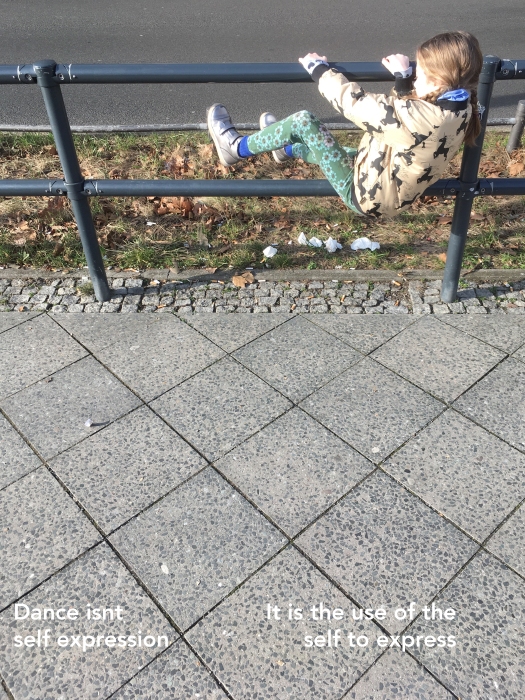
“The point of movement scores/improvising and subsequent discussion is to compel students to make specific aesthetic choices and then to gain consciousness both of the particular choices they have made and the reasons why they (or someone else) might make a similar or different choice.”
The original text below:
“The point of compositional prompts and subsequent discussion is to compel students to make specific aesthetic choices and then to gain consciousness both of the particular choices they have made and the reasons why they (or someone else) might make a similar or different choice.” (205)
Larry Lavender Predock-Linnell & Jennifer Predock-Linnell (2001) From Improvisation to Choreography: The critical bridge, Research in Dance Education, 2:2, 195-209