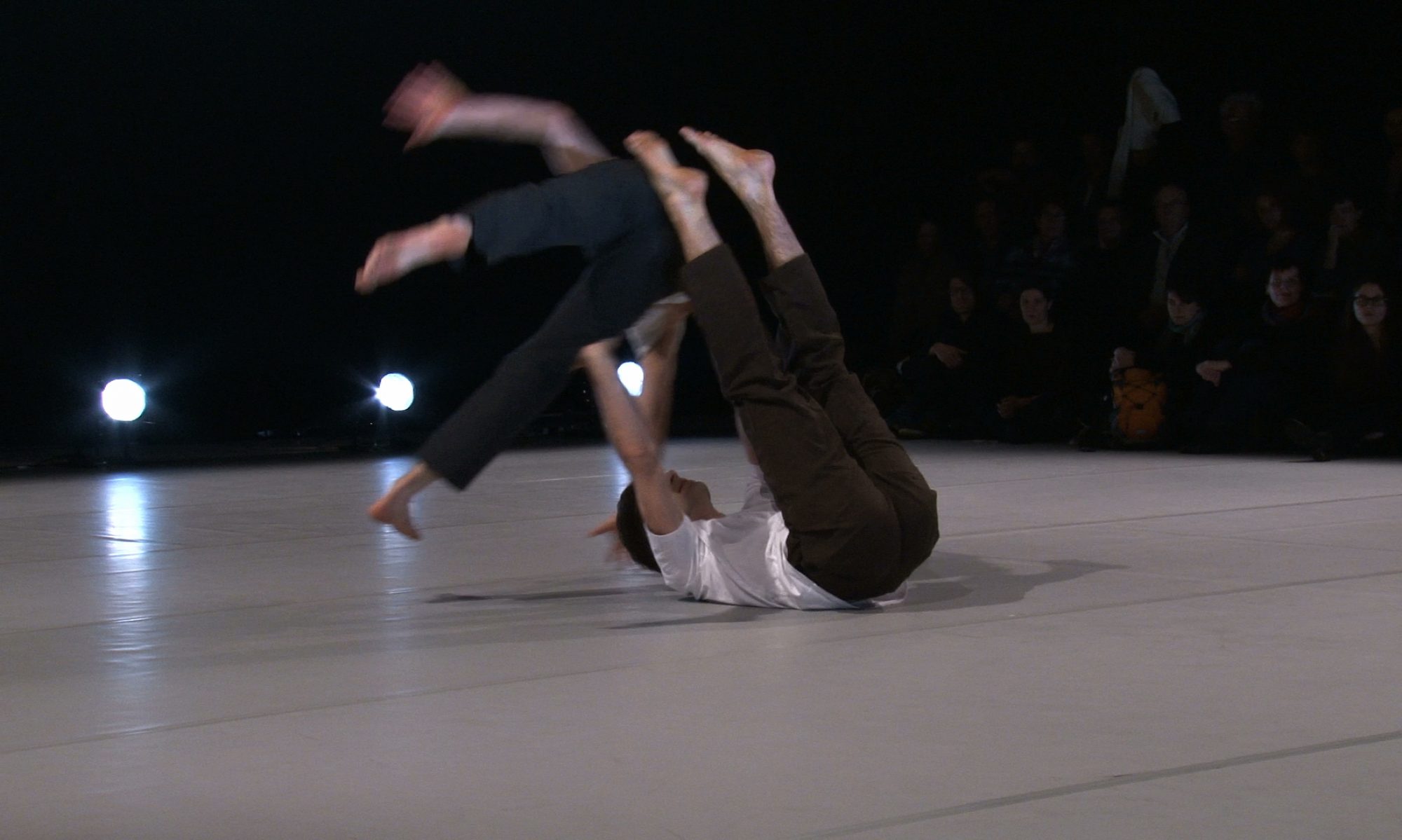
A neural perspective on SIDM
Consider the problem that dancer has to solve in the context of complex action planning, say engaging in solo improvised dance/making (SIDM) for 20 minutes within a given stage space. A variety of goals and subgoals – with their concomitant perceptual cues and motor tasks – need to be coordinated in such a way that the distal temporal end-state is reachable via a series of successive previous states, each of which must be ordered in relation to each other in space and time. Moreover, the dancer must be sensitive to changes in the external environment. A problem at a given stage necessitates the re- coordination of an indeterminate number of intermediate stages, which must be adjusted flexibly, accurately, and perhaps quickly, in order to reach the end-state. In addition, unforeseen intervening stimuli must be judged to be relevant or irrelevant, and the correct ordering of spatial and temporal sub-tasks must be maintained despite distracters.
original text
Consider the problem that a control system has to solve in the context of complex action planning, say finding the right type of spaghetti at the supermarket. A variety of goals and subgoals – with their concomitant perceptual cues and motor tasks – need to be coordinated in such a way that the distal temporal end-state is reachable via a series of successive previous states, each of which must be ordered in relation to each other in space and time. Moreover, the system must be sensitive to changes in the external environment. A problem at a given stage necessitates the re- coordination of an indeterminate number of intermediate stages, which must be adjusted flexibly, accurately, and perhaps quickly, in order to reach the end-state. In addition, unforeseen intervening stimuli must be judged to be relevant or irrelevant, and the correct ordering of spatial and temporal sub-tasks must be maintained despite distracters.
from Uithol, Sebo, et al. “Why We May Not Find Intentions in the Brain.” Neuropsychologia, vol. 56, 2014, pp. 129–139.
spacetime
Real-Space Composition
be t/here

predetermination

Another definition of improvised dance
improvised dance – movement absent of teleology and not beholden to its precedent
SIF and Dance
The right dance therefore does not need to be “determined” in advance. There is no fully specified end-result on the basis of which the dance is realized. On the contrary, the dance is realized in practice because it is getting increasingly determined or developed within the landscape of affordances. The process of dancing can even have the determining, directed, character of nesting affordance for the dancers, because they are in the process of enacting a satisfying dance.
Original Text:
The right design therefore does not need to be “determined” in advance. There is no fully specified picture or description of the end result on the basis of which the design is realized. On the contrary, the design is realized in practice because it is getting increasingly determined or developed in acting within the landscape of affordances. The process of designing the sculpture can even have the determining, directed, character of nesting affordance for the architects, because they are in the process of enacting a satisfying design.
from –
Foregrounding Sociomaterial Practice in Our Understanding of Affordances: The Skilled Intentionality Framework
van Dijk L and Rietveld E (2017) Foregrounding Sociomaterial Practice in Our Understanding of Affordances:
The Skilled Intentionality Framework. Front. Psychol. 7:1969.
whatwhenhowwhy
composition – what
improvisation – when
aesthetic – how
narrative – why
“The point of movement scores/improvising and subsequent discussion is to compel students to make specific aesthetic choices and then to gain consciousness both of the particular choices they have made and the reasons why they (or someone else) might make a similar or different choice.”
The original text below:
“The point of compositional prompts and subsequent discussion is to compel students to make specific aesthetic choices and then to gain consciousness both of the particular choices they have made and the reasons why they (or someone else) might make a similar or different choice.” (205)
Larry Lavender Predock-Linnell & Jennifer Predock-Linnell (2001) From Improvisation to Choreography: The critical bridge, Research in Dance Education, 2:2, 195-209
Pablo and Salvador
Picasso + Dali = Masson
