There are known knowns; there are things we know that we know.
There are known unknowns; that is to say, there are things that we now know we don’t know.
But there are also unknown unknowns – there are things we do not know we don’t know.
– Donald Rumsfeld
I am curious what unknown Meg Stuart/Damaged Goods is venturing into with Violet that I saw at HAU 2 on October 30, 2013. The program states that “Stuart once again ventures into the unknown.” I would agree that she “has banished the socio-emotional issues that have coloured her previous pieces in order too concentrate on the kinetic and the abstract.”(from the program) The other pieces I have seen by her, Replacement and Do Animals Cry, dealt a lot with social and emotional issues as far as I could tell.
Is Violet a venture into the unknown in terms of logic, tool, or aesthetic? To concentrate on the kinetic and the abstract is not venturing into the unknown. That realm of inquiry has been and continues to be heavily investigated. Maybe the unknown refers to not knowing the results of a predetermined process. As someone who also makes performance work, I am curious to know what the known knowns and the known unknowns are in this piece. In other words, what was set(predetermined) and what was not(determined in the moment). I am guessing that the upstage line of five dancers was known; that they would undergo solo states work was known; that the diagonal of dancers from downstage right to upstage center stage was known; that the V shape of dancers was known; that the rolling clump of bodies was known.
I do not have an issue with elements, phrases, locations, etc. being predetermined in a piece. But if the first sentence in the explicative text in the program talks about venturing into the unknown, I want that unknown to be defined. Are the kinespheric processes unknown? Are the spatial configurations that will arise unknown? Is the sound unknown? Or are they using known processes to discover something unknown.
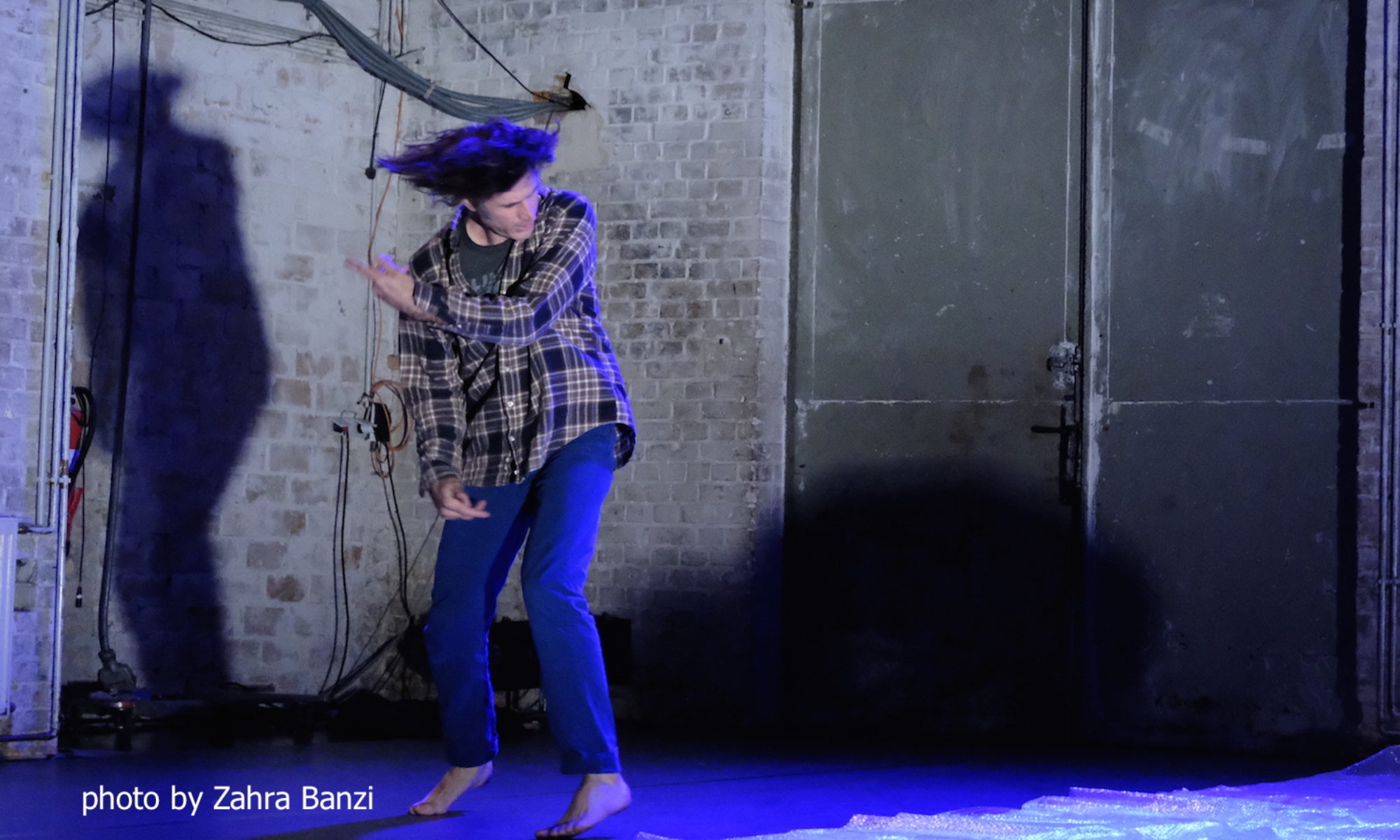
However the piece is constructed and whatever the choreographer’s intentions may be, I appreciated the events on stage as they gave me a framework upon which I could lay some of my own questions about performance. Simply put, I would say that Violet is a quintet of “balls to the wall” solos that are attempting to walk the fine line between ignoring the group and composing spatially with the group. Watching the performance through that lens, I could think about my work with Lower Left. The Ensemble Thinking work, as spatially clarifying and enlightening as it is, sometimes robs the dancer of a wild solo body. The outward focus on the group’s spatial relationships can stultify the individual’s expression. Violet, as I viewed it, is an inspirational, though not completely successful, step in the direction of co-mingling the wild low-brained body with a conscious and refined spatial awareness. I say unsuccessful because several times I saw dancer’s “drop out” of their solo body work and shift their location to complete a line or angle in space. Another point (and this might be a bit nit-picky) but the dancers used their right arms much more than their left arms to initiate and investigate movement.
The music by Brendan Dougherty does “produce a dense wall”. At its loudest, which is a good chunk of the time, the music I found overwhelmed the dance. Volume, in my opinion, is sometimes used for instant gravitas. The dancers’ movement became insignificant beneath the weight of the sound. At one point, a dancer screamed. I couldn’t hear her through all the racket. I could merely see the indication of a scream, a grimacing visage. Quite an image if you want to use a social-emotional lens, even stronger if you add the lenses of race and gender – a white male making so much noise the scream of a small Asian female cannot be heard. But we are in the kinetic and abstract so forget that interpretation. Despite the volume, I enjoyed the music.
The large brown wall in the back looked like it was tacked on. It was quite large but not large enough to envelope the theater/stage space and create a “space” within. From where I was sitting I could not see enough of a reflection in it to give me another perspective on the events on stage. The brown wall did, though, reflect the visible light spectrum nicely. Everyone likes a rainbow.
In explaining the title Violet, Stuart says that “Violet is the last colour in the spectrum, before ultraviolet, before the unknown, before the imperceptible.” Violet maybe the last color in the visible light spectrum right before ultraviolet. But it is not before the unknown. After ultraviolet rays are x-rays, gamma rays, and finally cosmic rays. Granted everything after the violet is imperceptible to the human eye and therefore, in a sense, imperceptible. Though we can sense prolonged exposure to ultraviolet rays after the fact – sunburn. But is she saying that something known but not perceptible with our five senses is actually unknown. Is the body the ultimate arbiter of known and unknown? If so, then why have the loud music and the brown wall? Let’s enjoy sweaty, spinal, rolling, screaming, walking, falling, running, shaking, flinging bodies for their own sake.
She is right, though. Violet is a great name for a rock band. Too bad these guys got it.