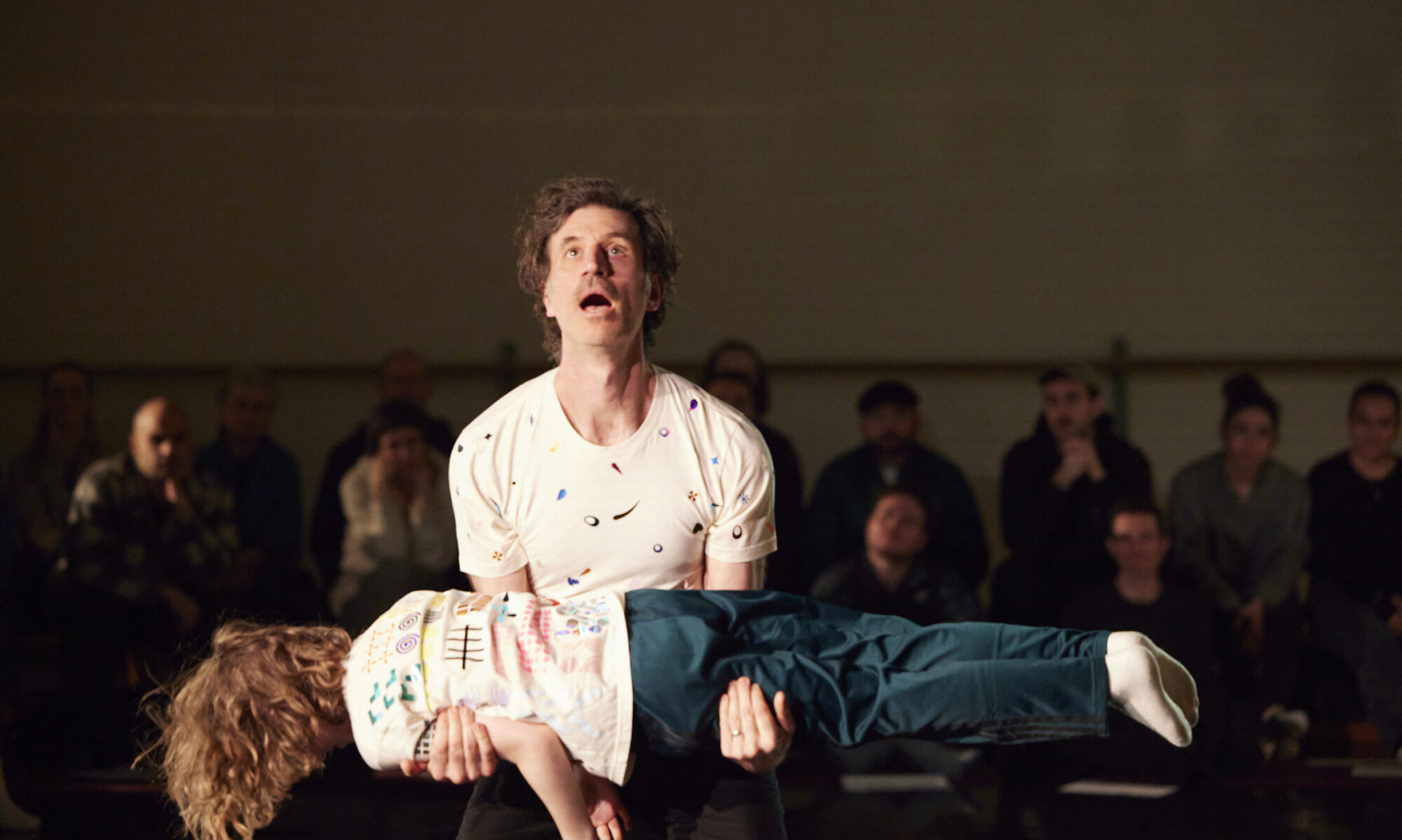
TanzNacht Berlin 2012
Insignificant Others
(Learning To Look Sideways)
An Kaler
What I read in the program: Together separately. Separately together. How can one perceive and analyse a collectively experienced, present moment? Three performers share a moment on stage. They go through a series of positions that let them become the bearers of ambiguous, almost static yet variable images. Connections develop between them which cause the moment to gently but clearly shift and their relationships to constantly charge and discharge. Through a series of interrupted yet connected sequences and situations a space is created in which performer and spectator share the potentiality of what comes next.
What I saw: a generic contemporary dance. They started standing in silence. They shifted slowly as the computer generated music with cracks, whistles and pops grew louder and louder.
Another reason I say generic is the type of movement. Though quite articulate and adept at it, the dancers didn’t offer much in terms of kinespheric originality as they stayed with the elbow initiated limp wrist movement that is quite fashionable.
Spatially, the dancers tended to be upstage and face away from the audience. Quite a lot of time was spent far stage left in the unlit section of the performance space. Was this a somatic spatial response to the audience or intentionally done to contrast the two moments when the three dancers were center stage?
One thing I like to watch when I watch ice-skating is when the skaters fall. Not out of a desire for schadenfreude, but I like to see how they react to an unscripted moment. I am guessing that Insignificant Othersis improvised or scored with landmarks and therefore mostly unscripted. A moment that I perceived as very unscripted was when one of the dancers, mid thrash, bonked against one of the lighting supports. Two other very unscripted moments involved two dancers almost colliding. Did these near collisions happen because the dancers were so involved in their own processes that they became unaware of the others on stage? Maybe this is the insignificant others bit. Ahh…and the (learning to look sideways) is that they aren’t directly relating to each other, but mostly responding to each other’s movement as opposed to other Viewpoints. But then they do take similar shapes when standing in front of the hanging rectangles.
Compositionally this piece was coherent. The movement ebbed and flowed. The music got louder, quieter, and came in occasional bursts. The lighting shifted and repeated. There were three dancers and three rectangles. So in that sense the piece held together.
But what didn’t work for me was the use of space by the dancers. I didn’t see a compositional choice (except in the two times of stillness center stage) but nerves and adrenaline causing the dancers to shrink back and away from the audience. Also, the piece was too long. Maybe I am too American and my sitzfleisch is not so developed. But I think it is more that I am a dancer. After seeing people flailing about articulately for 20 minutes, my mirror neurons are full and I want to get up and join in.
Some notes –
“How can one perceive and analyse a collectively experienced, present moment?” – Is this a rhetorical question? How about Viewpoints, Laban, amount of sweat, sound, sight, video, photography, Ensemble Thinking, touch, pressure und so weiter?
“…which performer and spectator share the potentiality of what comes next.” – a fancy way of saying the piece is improvised
“They go through a series of positions that let them become the bearers of ambiguous, almost static yet variable images. Connections develop between them which cause the moment to gently but clearly shift and their relationships to constantly charge and discharge.” – Another reason I say that this piece is “of the genus”. Can’t this be said about almost any piece? Especially the ambiguous part?
***********************
Propositon(s)
Laurent Chétouane
What I read in the program: The French director Laurent Chétouane has developed a unique language for dance. The six choreographies, developed over the course of the last few years, speak for themselves. Each new encounter with a dancer challenged and enriched the vocabulary of the work. For the TANZNACHT BERLIN 2012, five of the seven dancers who worked with Chétouane during this period lend their bodies to this language and give insights into their understanding and interpretation of the collaborative works, the shared ideas and the time they spent during rehearsals.
What I saw: Six dancers, not five. One Idea of line or semi circle giving focus to a solo. I remember one multilevel tableau instead of a line giving focus. Mostly the solos began and the ensemble would recognize that and create a Hot Spot for the solo. (Some might recognize the Ensemble Thinking vocabulary I am using.) Every dancer in the group had a solo before dancers went for another solo. The two dancers in purple had the most solos and the male dancer with long hair in green had, sadly, the fewest. Maybe he’s the new guy.
Also saw an odd mandibular action, mostly with the two dancers in purple. Everyone had their mouths open, and some occasionally moved their mandibles. Several times the soloists would break out in a funny grin, causing a tittering in the audience. These smiles were reminiscent of smiles I have seen during group faculty improvisations at festivals when everyone knows it’s headed downhill. Maybe this use of smiles was a distillation of that phenomenon and commentary on improvisations headed south.
What kept this piece from being generic was that it stuck with the same score for the entire time and kept running through the permutations of soloist and ensemble. Group improvisations frequently churn through so many scores, ideas, and movement themes (I have been in many of those!) and it was nice to see one that stuck to its guns, or gun, as the case maybe. But if they were going to stick with one score, they could have been a bit more adventurous in their investigation of it and expression with it.
This piece, too, was coherent – people running through the permutations of a score. No rabbits popping out of hats, or balloons appearing from pockets or other such non-sequitur surprises. Though, the mandible jiggle, like the three rectangles in Kaler’s piece, why?
A note – the last soloist before they repeated at one point had her left leg out to the side and rotated it to an arabesque as she rotated right. A beautiful moment!
**********
My issue with both pieces, was not so much the performances themselves, but how they were framed. The descriptions could fit most any piece out there. Kaler’s was “ambiguous”, dealing with the “present moment” and “what comes next”. Chétoune’s was about collaboration, sharing ideas, and time spent rehearsing.
If the framing doesn’t elucidate how these pieces are more than just iterations of our current genre of dance, then the pieces do not become anything more than an aesthetic experience. Either you like it or you don’t. Maybe that is what the creators are after – contemporary dance as entertainment.