The absence of an empirical definition of what is meant by improvisation has been an obstacle to conceptual clarification.
Improvising the technically pedestrian choreography
“While improvisation initially offered Jones a reprieve from the demands of technical training…” – page 115 from I Want To Be Ready by Danielle Goldman.
This quote refers to the choreographer Bill T. Jones. While it may be true that improvisation did offer Jones a respite from the rigors of technical training, I find that this statement sets up, or rather is indicative of an old and antiquated antagonistic binary about improvisation and technique.
I would say that good improvisation requires technical training. The opposite of improvisation is choreography. And to do choreography doesn’t require technical training but merely memory.
A dancer’s relationship to time, i.e., improvisation or choreographed, has nothing to do with technical training. Choreography can be technical or not, improvisation can be technical or not. Though, I would posit that untechnical improvisation isn’t improvisation, but merely futzing about, regardless of how enthusiastic it is. Choreography, on the other hand, is merely remembering a sequence of events.
Technical, pedestrian, improvised, choreographic…one does not imply the other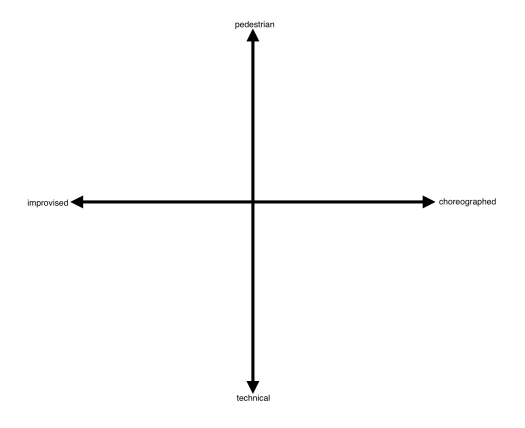
Knowing

3D Binary

Where is your #dance located? Applicable to body, space, time and…
Is CI a Cunningham chance operation?
‘The dancers are called on not to express a particular emotion, or set of emotions, but instead to develop refined coping mechanisms for creating continuity between disarticulated movements while remaining sensitive to their location in space. They must keep time without musical cues; sense the presence of the other dancers on stage; know blindly proprioceptively, what these other dancers are doing; and adjust the the timing and scope of their movements accordingly, thereby expressing the “human condition” at hand. All this work is “expressive”-it belongs to the “category of expression”-insofar as it is demanded by a human situation on a stage and insofar as human situations on stages (or otherwise) constitute an embodied response to the present moment, an embodied response to the utterly unique conditions of existence at one given point in time.’ – Noland, C 2010, ‘The Human Situation on Stage: Merce Cunningham, Theodor Adorno, and the Category of Expression’, Dance Research Journal, 1, p. 55
In this quote, Noland is referring to Cunningham dancers dealing with the re-ordering of set phrase material. When she writes (or otherwise), she could be referring to a contact improvisation jam. I think it is a very apt description of an silent CI jam. In CI jams, dancers are constantly “using refined coping mechanisms for creating continuity between disarticulated movements while remaining sensitive to their location in space.” [Though, how much contacters are actually aware of the whole space is open for debate! IMHO]
What people do at CI jams is, I would say, “an embodied response to the present moment, an embodied response to the utterly unique conditions of existence at one given point in time.” [Though, how much is actually an embodied response and not actually another iteration of habit is also open for debate. IMHO]
Are Cunningham choreographies that are governed by chance operations a contact improvisation jam?
Are contact improvisation jams a piece of choreography by Cunningham?
Paxton danced for Cunningham, after all.
The Axis of Actvity

Jam ~ Performance
A Jam is a situation in which all participants have equal access to movement, location, and observation.
A Performance is a situation in which participants have unequal access to movement, location, and observation.
Contemporary Contact Improvisation…or achieving the full potential
If, as some have stated contemporary dance is about the search for and exploration of potential, then contact improvisation in its nigh-omnipresent hetero-normative iterations is not contemporary as the hetero-normativity represents merely a third of the potential permutations of the duet based on biological sex.
Extending this thought to the duet in relation to number, the normativity of the duet in relation to the physical practice of the form is also a limitation of potential. A dancer of CI, in order to make use of the full potential of the form, should be able to dance with anyone in the place of practice and not be limited to one person.
In order to achieve the full potential of the form, and thus bring CI into back into contemporality, practitioners of the form must move beyond the hegemony of the hetero-normative duet.
Another Definition of CI
Contact Improvisation is the simultaneous exploration of, experimentation with, and execution of physical and perceptual attention to the location, duration, and operation of one or more touching or potentially touching surfaces between two or more bodies.
Heart and Soul
Paraphrasing Schuller and Duke-
‘”Improvisation is the heart and soul of [contact improvisation].” However, [contact improvisation] is not the heart and soul of improvisation, and they are definitely not one and the same.’ – John Henry Duke, Teaching Musical Improvisation: A Study of 18th and 20th Century Methods, pg. 16