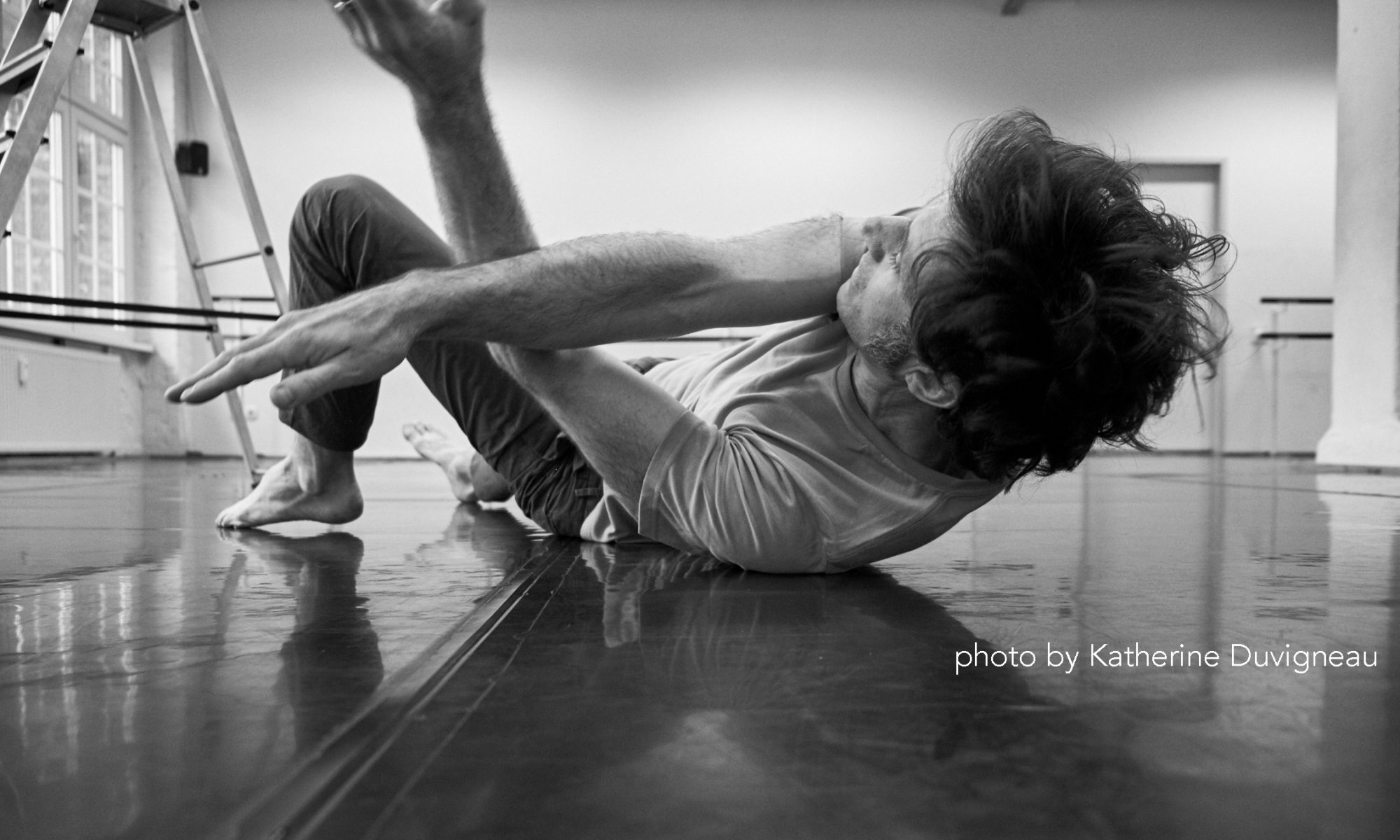
How long before Xavier Le Roy puts this on stage?
[youtube http://www.youtube.com/watch?v=K9ALaS8lHGM&w=425&h=349]

the philosophy of movement
How long before Xavier Le Roy puts this on stage?
[youtube http://www.youtube.com/watch?v=K9ALaS8lHGM&w=425&h=349]
Choreography and improvisation are both a set of rules to follow during a performance.
One is usually a longer more detailed set; the other is shorter.
One has a wide range of acceptable outcomes; the other has fewer.
Here are some links to compositional ideas for painting and photography that I think apply to dance. Especially in relation to the instant choreo composition modality of Ensemble Thinking.
The Rabatment of the Rectangle
http://en.wikipedia.org/wiki/Rabatment_of_the_rectangle
The Rule of Thirds
http://en.wikipedia.org/wiki/Rule_of_thirds
The Rule of Odds
http://photo.stackexchange.com/questions/11475/what-is-the-rule-of-odds
Placement of Elements
http://painting.about.com/od/composition/ss/composition-painting-elements.htm
The Painting’s Secret Geometry
http://www.francois-murez.com/composition%20en.htm
p.s.
if dance is a visual art, why are the people who watch it called an audience?
Arts, as they descend into entertainment, cling to seriousness and sadness as a means of validation. This leads to dismissal of humor as less valid because it highlights the lack of valence of the performing arts as affecting any real change.
Descend into entertainment can also be read as becoming a commodity; appropriated by the capitalist market.
Hot off the mental press, coming at you live. As I ponder more and more of late about what to do in life, what path to follow or forge, all due to grad school and the birth of my first child, I think now about a binary of touring vs. making work. Is it even a binary? All these thoughts could be because I am just lazy and don’t want to do the work of getting my work out there. Writing grants, making packets, sending them out, schmoozing with presenters is a lot of work. Work that scares me. Maybe scares me is the wrong word.
I see other artists who tour and get presented and looking at their work, I don’t understand why they were presented, why the director of theater X gave them a 6 month residency. Must be in the documentation the artist presented, or maybe the kind of work s/he does is more easily marketable. Could be that my work is just not interesting. Don’t get bitter, don’t get bitter, don’t get bitter.
And grad school, context, context, context. Shit in on context smell, a different context helps make food. So maybe I need to rewrite all my performance blurbs so the context is sexier. And then write the grants, make the packets, and hound the presenters. But for whom am I making the work? Because I work in a time based medium that can be viewed as performative, does that mean the work is made for other people? How many painters make work for themselves, and have studios full of canvasses not meant for general consumption?
And now a child! What a wonderful bundle of joy and confusion. Her laughter, smiles and cries make everything, all my frustrations disappear. But then they come back. Provide, provide, provide…that is what a parent, a father is supposed to do. Hack away at performing, etc to make money to provide. But then touring could conflict with schooling. School is still a couple years off yet.
So, do I finish this schooling, get my MA then jump out of the artistic realm into the academic realm to get health insurance, income to provide? Just as much chance of getting a big grant. Both require applications and schmoozing.
Maybe this is all justification for laziness. Artistic high road and all that. Even now all these thoughts/emotions I don’t want to bother to craft into a polished blog post. But isn’t this more just for me as a place to vent?
No one reads this anyways…
waaah
waaah
waaah
The need for contextualization exists because humans can not free themselves from the good-bad binary. That being said, contextualization is also needed because we are now in a post-disciplinary moment. How long that moment will last is another question.
Because we are in a post-disciplinary time and still are saddled with the evaluative binary, we need contextualization to help us determine where a given work of art/documentation/performance/representation lies on that spectrum. For better or worse, we are no longer saddled (not really but roll with it) with the evaluative binaries of disciplines, which are themselves shorthands for contextualization.
Choreography:
That which has a higher degree of reproducibilty a larger percentage of the time.
Improvisation:
That which has a lower degree of reproducibility a smaller percentage of the time.
In order to relate what I saw without being descriptive I will offer a short list of whats that I saw:
1. a tattoo
2. a cube
3. black tape
4. gestures
5. white tape
6. a hypodermic needle
7. blood
My feedback about the piece would be to simplify. The piece has at least three different pieces in it – Man with Cube, Man with Tape and Man with Needle. He should pick one of them and investigate it more deeply. I would suggest that he keep his manipulation of the tape to a minimum and not rearrange the tape once it is on the wall. Also I would suggest that the black tape movement section occur further downstage facing the audience. The tape is already abstract and geometric and his focal and spatial choices re-enforced that. Maybe it was his intention to replicate the impersonal nature of the tape. But what I saw was more of a coping mechanism than an artistic choice.
Black tape plus movement plus white tape plus the downstage space plus low level movement plus text plus needle plus blood. Eight dimensions in all. Is this piece, then, about the progression towards the multidimensional, the ultra dimensional he said he was seeking? I do not know. I can not say whether or not this piece worked as I do not know what he was trying to achieve. I can say whether or not I liked the piece. I did not. But whether or not I liked it is of little importance. I can say what it made me think of. The use of the cube made me think of Donald Judd. The black tape pictographs on the white wall made me think of Lawrence Wiener and Robert Motherwell. The piercing of the skin made me think of Chris Burden and Marina Abramovic.
Any of these references, though, is at best a stretch and more present in my perception of the performance than in Riccardo’s presentation of the piece. This brings up the question of what does an audience need to know about the work. Do we need to know what the artist knows? Do we need to have the same frame of reference? Do we need those references to get out of the piece what the artist put into the piece? Is it important for the viewers to get what the artist is saying? Or is the artist creating something for us the respond to with our own references?
Despite not liking it, I feel that of the pieces I saw yesterday this piece had the richest vocabulary to be investigated. And I intend on taking his Man with Tape piece and investigating it further.
Below is a reworked critique of a dance piece I saw in 2009. This was part of my application for the SODA program here in Berlin. Here is the “original“
Accords by Thomas Hauert/Zoo, which I saw last summer during Tanz im August, consisted of sections delineated by performers entering or exiting the stage through the spaces between the back panels. The movements within these sections were governed by either the simultaneous initiating and halting of movement, flocking, or awkward partnering. Flocking is when people move in a clump changing spacing/facing with no discernible leader. Awkward partnering is skilled bodies coming in contact in an improvised manner consciously eschewing the Contact Improvisation movement paradigm.
As someone who performs and teaches the tool of improvisation, I appreciated the clarity in this improvised performance. It is very satisfying to see an improvised piece by people who have been working together for more than just a handful of rehearsals. All to often, improvised performances have three rehearsals. During the first one, half of the group doesn’t show and the half who are there just talk. For the second rehearsal 80% of the cast is there and some dancing actually happens. The third rehearsal is on stage in front of the audience, i.e., the performance. In Accords, the hours sweating together in the studio came through during the performance. I saw no moments of searching or moments of awkwardness when performers are in between inspirations.
Dance improvisation is a nascent art form. Because of this, there are many assumptions about improvisation and its uses. The three main assumptions about improvisation are that it is not supposed to be rehearsed, be well produced, or have a point. Also due to the newness of it, improvisation based work is in a vicious cycle. The work is underfunded, therefore the work cannot be well rehearsed and produced. The work is not rehearsed, so the quality is not consistent. The quality is not consistent so producers and curators do not want to show the work. The work is not shown, so artists making improvised work can’t get funding. They can’t get funding so they can’t rehearse. The cycle continues.
Thomas Hauert, it seems, has been able to break this cycle and to get beyond two of the three main assumptions about improvisation. His piece Accords is well rehearsed and has a high level of production value. The lighting was not left over from the previous performance. The costuming, consisting of black mesh body suits over primary colored pants and shirts, was not thrown together right before the performance. The set, more than just a black box, was simple — black, one meter wide panels, each the height of the stage. The panels, which covered the back wall, were wide enough apart for the performers to slip between them. At times acting as either a visual backdrop or an obstacle course for the movement, the set was well integrated into the performance.
Where Hauert failed was topic. His piece had all the production value of a choreographed piece, but not the point of a choreographed piece. An improvised piece can have just as much of a point as a choreographed one. What was Hauert trying to reveal to the audience besides the tool of improvisation? Is it the means or the end? If improvisation is what he was trying to show the audience, he succeeded. We saw people improvising. But listening skills and group awareness in and of themselves do not make a good piece. If all it takes to make a good piece using improvisation is good listening skills then any sequence of memorized movement is good choreography. This, we know, is not the case. Even if improvisation itself were the topic of the piece, nothing was developed strongly enough to become the point of the piece. The dancers did not work flocking, group timing or any of the tools I recognized for such an extended period of time to take it to a new level.
Maybe Hauert intended to provide the audience with an enjoyable visual and auditory experience for 90 minutes. As an artist using similar tools, I want to see the tools create something besides themselves.